Digital Customer Experience Trends for 2027–2030: AI, Personalization, and the Future of CX

How many companies are your customers comparing you to? Ten? Fifteen? Twenty?
Actually, they are not comparing you to your direct competitors at all. They are comparing you to the best digital experience they have ever had, whether that comes from Amazon, Spotify, or their favourite food delivery app.
That is the new reality of customer experience. And if you are not meeting that benchmark, you are losing ground. According to PwC’s 2025 Customer Experience Survey, 29% of consumers walked away from a brand after just one poor experience.
So what do you need to not just survive, but win on this battleground? And how will customer experience change by 2030? In this article, we will give you the answers.
What Is Digital Customer Experience (DCX)?
Digital customer experience (DCX) is the architectural totality of all online user interactions that shape their ultimate perception of your brand. In the 2027–2030 era, as the boundaries between the physical world and digital technology blur entirely, DCX has evolved into the primary battleground for customer retention.
Key Digital Touchpoints
DCX encompasses every stage of the digital customer journey. Depending on where a consumer stands in their lifecycle, they will interact with various critical touchpoints, including:
- Websites
- Mobile Applications
- AI Agents for customer service & Live Chats
- Phygital Technologies
- Social Media & Streaming platforms
- Integrated Messengers and SMS
The Core Customer Experience Trend for 2027–2030: Autonomous AI
What Is Autonomous AI Customer Experience?
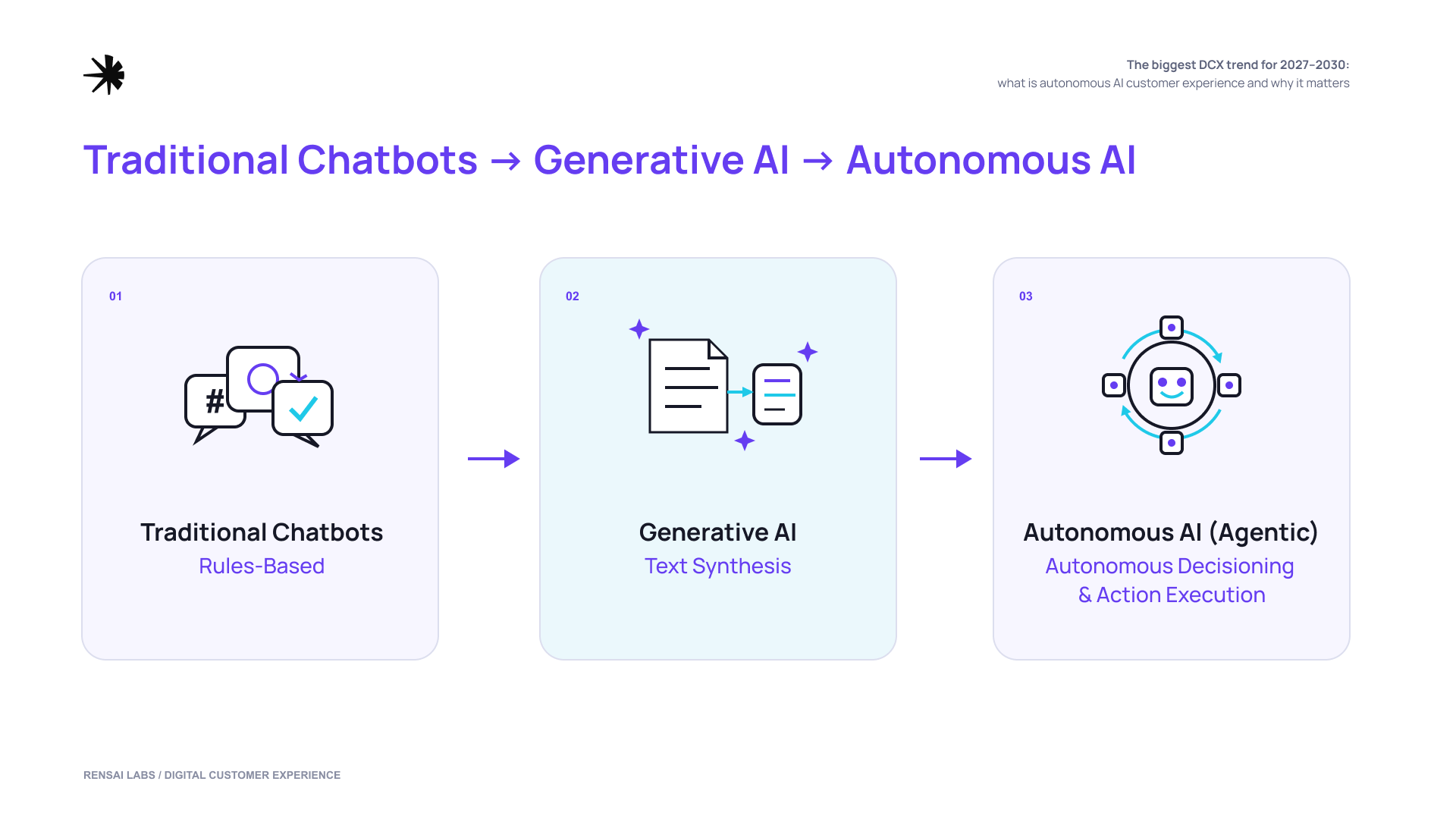
Autonomous AI CX is an approach to digital customer experience where autonomous artificial intelligence makes decisions and executes complex tasks without human intervention.
Unlike generative AI, it learns from data, adapts to new situations, and operates independently. It includes:
- AI-powered chatbots
- Virtual assistants
- Predictive analytics systems
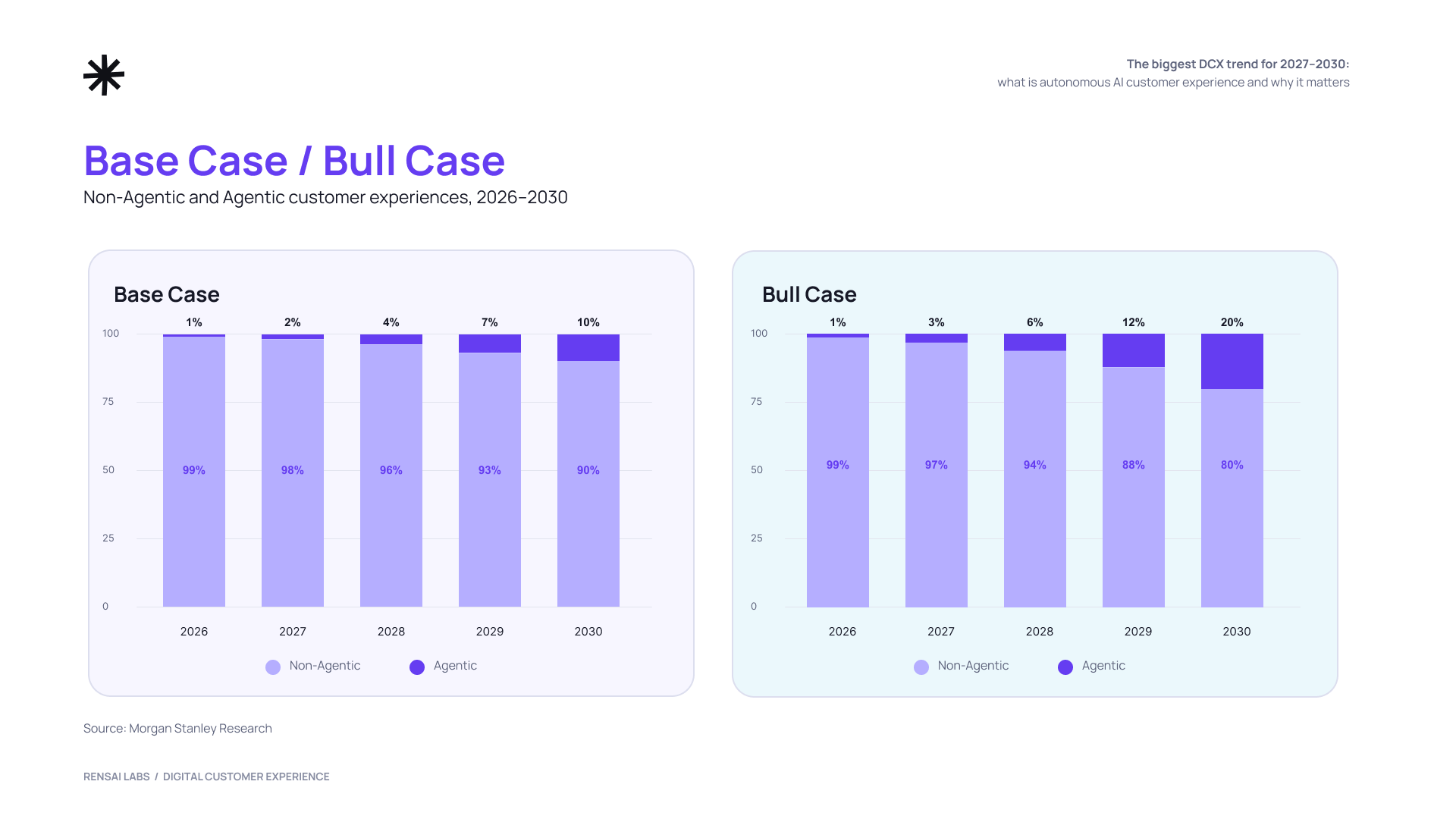
The commercial impact of this technology is already scaling rapidly. According to research by Morgan Stanley, between 30% and 40% of US consumers already leverage AI tools to assist with their shopping journeys. Furthermore, autonomous AI Agents are projected to capture a 10% share of online retail sales in a baseline scenario, with an optimistic outlook driving that figure up to 20%.
How Do Autonomous AI Agents Improve Customer Experience?
An AI agent operates as a digital personal assistant acting on behalf of your customers. Instead of merely delivering static information, it actively executes complex tasks: comparing prices, making autonomous buying decisions, planning upcoming travel, and etc.
Deploying an autonomous customer experience framework drives real-time contextual adaptation, 24/7 support, and a genuinely frictionless omnichannel journey.
How It Works
Automated bookings
Users can simply describe what they need to book in plain, conversational language. Then the AI Agent independently analyzes the user’s comprehensive profile, factoring in unique personal preferences, active loyalty programs, and historical behavior, to automatically secure and book the absolute best option available.
Product recommendations
Autonomous AI agents possess the unique ability to factor in immediate, real-time context – such as specific live events like sports matches – to serve the most relevant content or products at that exact moment. By continuously analyzing user behavioral data, AI agents can automatically detect subtle purchase intent signals, proactively offering goods or services precisely when the customer needs them most.
Service resolution
Because autonomous AI dynamically adapts to novel scenarios and operates independently, these systems can resolve complex customer inquiries entirely without human intervention.
Agentic AI transforms customer support by:
- Evaluating user intent and underlying data from active conversations, support tickets, or system logs
- Validating information against strict business rules, historical resolutions, and policy constraints
- Assessing the user’s emotional state in real time to deliver the most empathetic and optimal solution
- Processing intricate backend tasks such as account updates, identity verification, or flight rebookings
- Automatically updating internal knowledge bases and refining future decision-making based on past resolution outcomes
Strategic Business Benefits
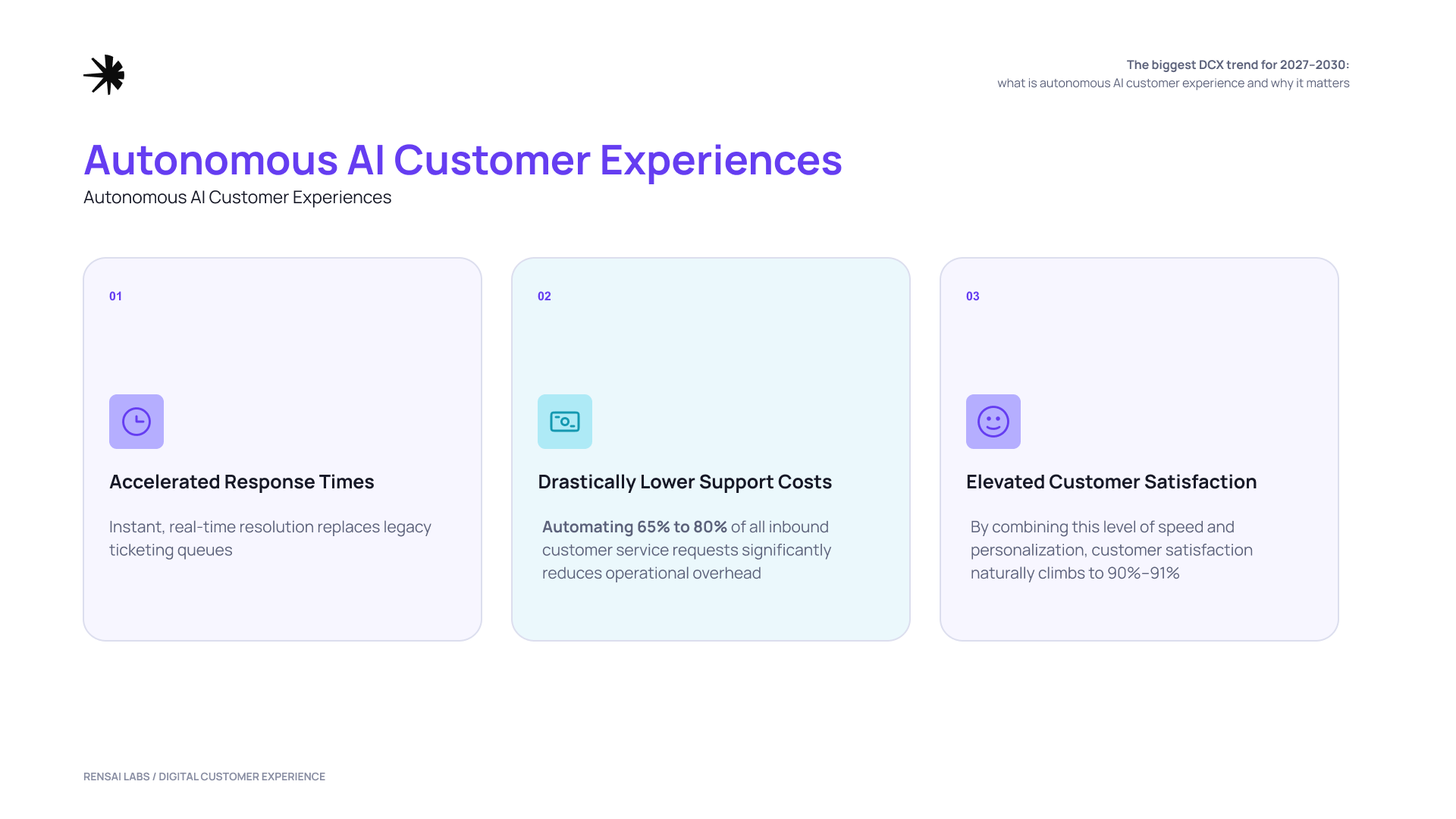
Transitioning to an autonomous customer experience framework powered by Agentic AI delivers accelerating response times, reducing operational overhead of all inbound customer service, and elevating customer satisfaction (CSAT).
Looking ahead: what else will shape DCX in 2027–2030?
01 Hyper-Personalization Powered by Real-Time Data
Traditional personalization relies on static data like names or broad demographics. In 2027–2030, hyper-personalization leverages machine learning and real-time analytics to create individualized experiences by continuously synthesizing live data streams:
- Active browsing behavior and immediate preferences
- Physical location
- Transient contextual factors, such as local weather or the exact time of day
Why is personalization important in customer experience?
In the 2027–2030 era, the objective of hyper-personalization is to maximize Customer Lifetime Value (CLV) by anticipating customer churn long before users even make the conscious decision to leave.
Modern consumers expect a brand to instantly recognize them and demonstrate an intuitive grasp of their entire cross-channel interaction history. Research by Deloitte & Meta highlights this shift, showing that 80% of US consumers are significantly more likely to make a purchase when brands offer a deeply personalized customer experience.
Key customer experience technologies:
Context-Aware Recommendations
Dynamic suggestions based on live external and behavioral data.
Dynamic Interfaces
Automated layout restructuring to surface high-priority modules instantly.
Intent Recognition
Predicting buyer goals before they are explicitly typed or spoken.
02 Zero-Click Customer Journeys
In the late 1990s, Amazon rolled out its 1-Click purchasing system, driving up conversion rates and average order value (AOV) while tackling a massive e-commerce headache of the era – cutting cart abandonment rates nearly in half.
What if you could shrink the customer journey down to the absolute minimum? That is exactly what the zero-click concept is designed to do.
In a zero-click model, the traditional sales funnel collapses into a single, seamless interaction with agentic AI.
What does this look like for the consumer?
- Using voice or conversational AI to find, compare, and purchase products instantly through a single prompt.
- Ordering everyday goods and household essentials automatically before current supplies run out.
- Tracking actual service usage in real time to optimize pricing plans and automatically shift users to the most cost-effective tier.
How businesses can prepare for agentic customer journeys
Generative engine optimization (GEO)
Adapt web content to ensure AI agents recommend your brand first.
Data readiness
Standardize product feeds and implement precise Schema.org structured markup for real-time inventory sync.
Tokenized payment gateways
Enable checkout systems to process shared payment tokens from AI agents securely.
Next-gen commerce infrastructure
Adopt protocols such as the Agentic Commerce Protocol (ACP) backed by Stripe and OpenAI, or Google’s Universal Commerce Protocol (UCP).
Proprietary channel control
Strengthen owned platforms to maintain direct customer relationships.
Next-gen analytics
Track share of model voice and LLM visibility instead of legacy traffic metrics.
03 Emotion AI and Sentiment-Aware Experiences
Understanding Customer Emotions in Real Time
Emotion AI is a suite of technologies that analyzes multimodal behavioral signals (voice inflection, facial expressions, and semantic context) in real time.
The most prevalent technologies driving this shift will include Computer Vision (detection nuanced human emotions through micro-expressions and facial mapping), Voice AI (analysis vocal expression and acoustic patterns, instantly identifying customer confusion, joy, or distress), Textual Analysis (decoding sentiment, intent, and underlying tone across emails, instant messages, and customer reviews).
What are Sentiment-Aware Experiences?
Once real-time emotional data is captured, customer engagement systems must dynamically adapt their behavior to match the user’s state. This capability defines Sentiment-Aware Experiences — the systemic capacity of digital interfaces to adjust their tone, routing, and responses on the fly. It enables technology to interpret complex communication nuances, such as successfully distinguishing biting sarcasm from genuine praise.
The primary benefits of deploying this technology lie in driving core business metrics:
- accelerating customer retention
- maximizing acquisition
- boosting cross-sell revenue
Furthermore, according to Zendesk reports, utilizing Sentiment-Aware Experiences cultivates long-term brand loyalty by directly fulfilling modern user demands, especially considering that 61% of consumers already expect AI to recognize and dynamically adapt to their personal emotional state.
| Healthcare & MedTech | E-Commerce & Retail | Support & Operations |
|---|---|---|
| Diagnostic Voice AI 24/7 Virtual Therapy |
AI Shopping Agents Predictive Stocking |
Supervisor Assist Churn Interventions |
04 Unified Omnichannel Ecosystems
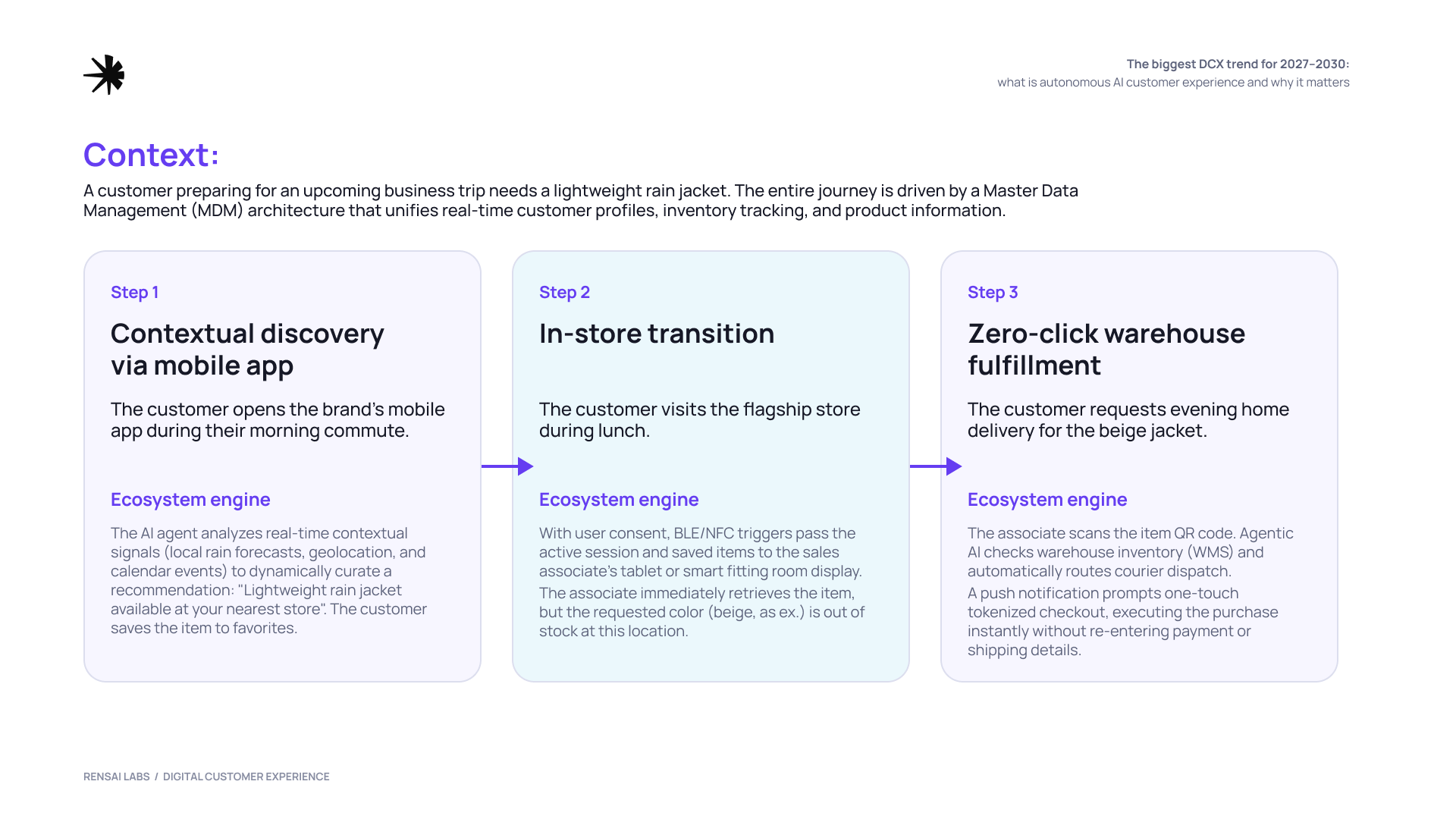
A channel-less experience eliminates the boundaries between sales channels, digital touchpoints, and backend systems to deliver a single, continuous customer journey. While traditional omnichannel strategies focused primarily on expanding presence across multiple channels, they frequently produced “automated fragmentation” and information silos.
In a unified ecosystem, enterprise operations shift focus from managing channels to resolving issues. The platform maintains a persistent thread of context, interaction state, and absolute memory, ensuring that device transitions remain frictionless and every touchpoint operates with complete situational awareness.
How it works
05 Immersive Customer Experiences
The Evolution Beyond Traditional Interfaces
The technological development of Augmented Reality and Virtual Reality is moving rapidly. Brands are transforming their physical spaces into phygital and digital infrastructure, aiming for a seamless and intuitive customer experience.
Core Technologies
Augmented Reality (AR)
Enhancing the real world with digital objects, where physical and digital coexist and interact in real-time.
CX Examples:
- Virtual showrooms
- Virtual try-on for eyewear and makeup
- Clothing visualization on different body types
Virtual Reality (VR)
Complete immersion of a user into a digital world. It allows users to step into an artificial, computer-generated environment and interact with it in real-time.
CX Examples:
- Pre-construction walkthroughs
- Design customization
- Virtual car showrooms
- Reducing uncertainty before booking
- Customer onboarding and education
Spatial Computing
Integration of digital content into real three-dimensional space, unbound by physical screens.
CX Examples:
- Virtual shelving, store assistants, and interactive content
- Full-scale 3D model rendering for design review and on-site coordination
- Surgical procedure training in simulated real-world environments
- Analysis of worker movement patterns, machine interactions, and task durations
Digital Twins
A dynamic virtual copy of a physical object, device, process, or entire system, updated in real-time using data from physical sensors.
CX Examples:
- Customer journey simulation and testing
- Real-time hyper-personalization
- Predictive customer service
- Experience-based product testing
- Early detection of drop-off patterns and automated high-value customer retention scenarios
Critical Enablers of Effective DCX Transformation
A successful digital customer experience (DCX) transformation requires balancing technical innovation, regulatory boundaries, and human touchpoints. Beyond system integration, enterprises must master three strategic pillars to ensure long-term resilience and customer trust.
Privacy-First architecture: 86% vs 80%
As noted above, 80% of US consumers are significantly more likely to make a purchase when brands offer a deeply personalized customer experience. At the same time, US companies face the so-called “privacy paradox,” as 86% of consumers express deep concern over the security of their data (Forbes).
What should companies do in this situation? The primary objective is to strike a balance between these two extremes: personalization and security.
Best Practices
Consent Management
The core principle of modern consent management is shifting from passive notification to an active, informed user choice prior to any data collection.
This principle is built on:
- Prioritizing prior (opt-in) consent
- Proper technical script initialization
- Automated handling of Global Privacy Control (GPC) signals
- Eliminating dark patterns (interface manipulation) designed to force tracking consent
- Recording and maintaining precise consent logs
First-Party Data
Collecting behavioral data (purchase history, viewed pages) directly through a company’s owned channels with explicit user consent.
Zero-Party Data
Collecting data that customers voluntarily, intentionally, and proactively share with a brand (preferences, purchase intent, and personal context) via interactive quizzes, surveys, or customer preference centers.
The “Give-to-Get” Concept
Customers are willing to share their data when they see a direct, transparent value exchange (e.g., precise size matching, tailored discounts, relevant recommendations).
Transparent Communication
Trust is built where a brand communicates the rules of the game openly and clearly. For users, clear privacy policies, explainable AI recommendations, intuitive privacy toggles, and explicit technology disclosures are essential.
Digital Accessibility
Digital accessibility is the practice of making all digital touchpoints easy to navigate and understand for everyone, including users with disabilities.
Why Inclusive Design Matters
Adhering to global standards (like WCAG) through inclusive design, screen-reader compatibility, and keyboard navigation is no longer optional. By 2027–2030, accessibility is a direct signal that a brand respects every user, while ignoring it risks alienating up to 20% of the market.
Accessibility Trends Through 2030
In March 2026, the W3C published updated drafts of the WCAG 3.0 Guidelines and the accompanying WCAG 3.0 Explainer. While currently in draft form, it represents a shift in how digital accessibility is measured, implemented, and governed across enterprise ecosystems.
Looking toward 2030, these guidelines introduce concrete, product-level engineering and design requirements across all digital assets:
- Cognitive accessibility and plain language requirements
- Deep UI personalization and visual customization
- Cross-platform and spatial (AR/VR) accessibility
- Dynamic data and media accessibility
| AI-powered accessibility | Voice interfaces | Adaptive experiences |
|---|---|---|
| Computer vision models parse dynamic screen layouts in real time and automatically generate semantic accessibility trees for complex visual elements.
On-device models also enable real-time sign language recognition (SL2T) and gesture tracking, allowing Deaf and non-verbal users to search catalogs and input form data using native gestures. |
Natural language processing replaces multi-layered visual menus with hands-free voice dialogue. Users with visual or motor impairments can complete full purchasing and account management workflows solely through spoken commands. | Enterprise design systems embed accessibility into core component tokens. Interfaces automatically adjust contrast, typography scaling, and spacing based on user system preferences, ensuring clean reflow up to 200% text enlargement without layout disruption. |
Human + AI Collaboration Models
Why Humans Are Still Essential
Data shows that American consumers are increasingly exhausted by ‘synthetic empathy’ and artificial politeness. According to Glance 2026 CX Trends Report, over 75% of users report frustration when an AI agent masks functional limitations behind overly polite, apologetic language.
When a bot spends multiple turns offering rehearsed pleasantries instead of resolving an issue, customers perceive it not as good service, but as ‘engineered insincerity’, a polite barrier designed to delay access to human support.
The Best Hybrid CX Strategies
AI Co-Pilots for Support Agents
Artificial intelligence does not interact with customers directly. Instead, the AI analyzes the customer’s history and the active dialogue, instantly generating personalized response drafts or suggesting necessary actions (such as requesting meter readings or checking transaction status). The human agent reviews the proposed draft, refines it, and sends it to the customer.
Guardrailed Frontline Automation
Automating the closure of simple inquiries at the frontline, but within strict, legally and technically defined boundaries for the AI. The AI agent acts as the initial responder exclusively for tightly scoped topics: pricing tiers, payment dates, and basic account configurations.
Contextual and Risk-Based Routing
The system dynamically decides when to hand off the conversation to a human based on a deep analysis of customer behavior and issue categorization.
Automating Routine to Deepen Customer Understanding
AI handles up to 70% of technical routine (password resets, standard returns, shipment tracking). As a result, the saved working hours of experienced specialists are purposefully reinvested into proactive initiatives: conducting live, in-depth customer interviews, executing churn-prevention strategies, and gathering detailed qualitative product feedback.
Conclusion: Winning the 2030 Customer Experience Battleground
As we look toward 2030, the rules of engagement in digital customer experience have fundamentally changed. Consumers no longer compare brands to direct competitors. They judge them against the absolute pinnacle of digital convenience.
Winning on this new battleground requires a shift away from siloed tools and reactive support. Organizations must transition toward an autonomous, unified ecosystem where agentic AI drives real-time personalization, zero-click commerce, and frictionless omnichannel journeys. However, technology alone is not enough. Long-term leadership will be defined by how well companies balance automation with rigorous privacy standards, digital accessibility, and authentic human empathy.
The transition to autonomous DCX is already underway. The question is not whether your organization will adapt, but how fast you can build the architecture to lead.