Popular Trends in Energy & Utilities Industry

Which software trends in the energy and utilities industry are already taking hold and will continue to define the market over the next five years?
If you work in the energy sector, you likely know the broader trends well. This article looks at the landscape specifically from a software perspective: what IT capabilities you can adopt now to maximize financial returns, streamline operations, and insulate your business from grid failures, station outages, and supply chain shocks.
We built this practical list around real project experience. Rensai Labs engineers contributed insights from their work on energy projects, while our marketing team, led by Irina Chirikova, organized the trends into five key areas:
- Artificial Intelligence
- Grid Flexibility & Virtual Power Plants
- Operational Technology Cybersecurity
- Supply Chain Transformation
- Fintech Solutions & Energy-as-a-Service Models
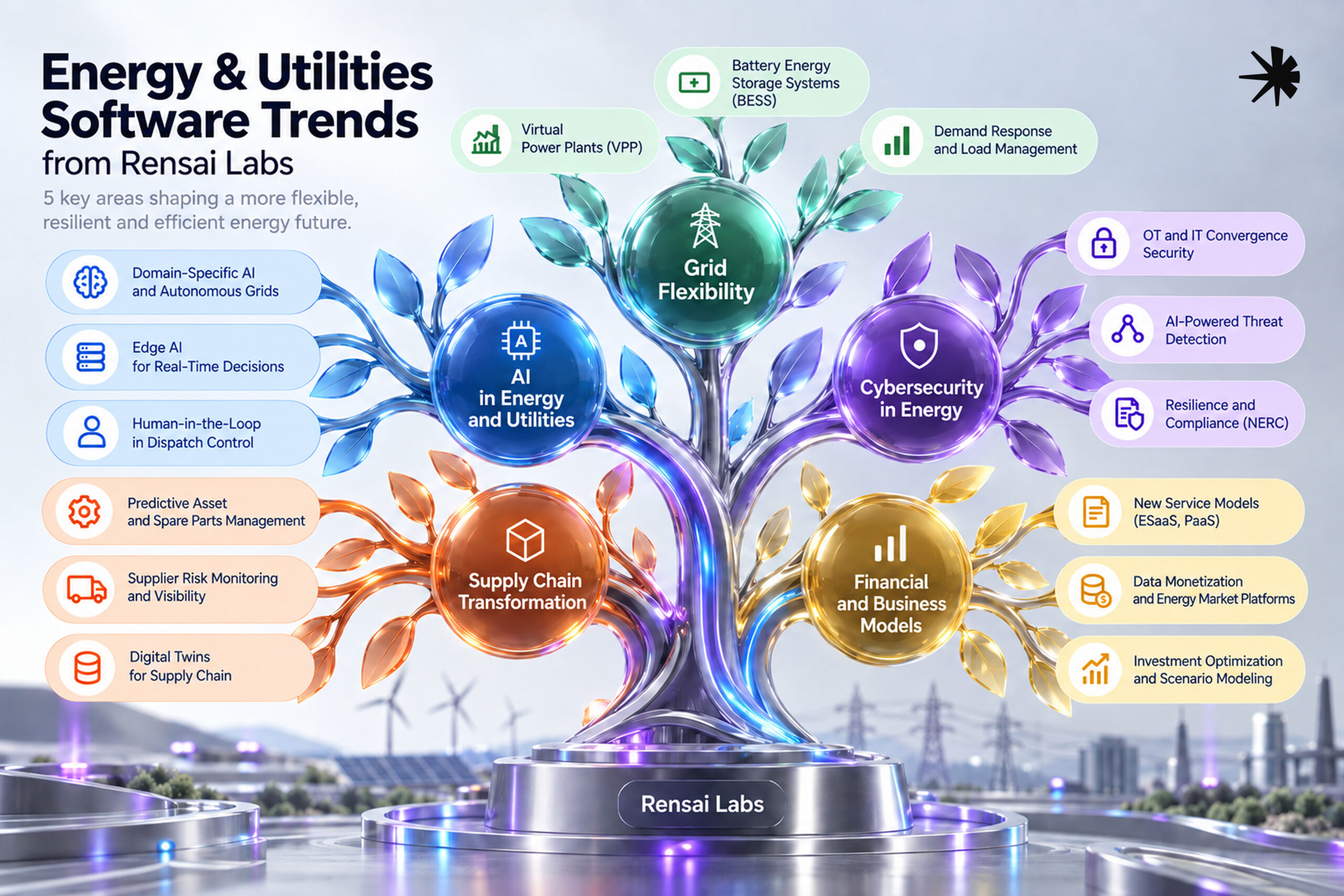
Below is the energy software trend tree, which breaks these five areas down into specific sub-trends. Each one is explored in detail in the sections that follow. The analysis combines insights from our engineers with reporting from Forbes, research from Gartner, Deloitte, and the World Economic Forum, and official guidance from the North American Electric Reliability Corporation (NERC).
Energy and Utilities Industry Trends for 2027-2032
Trend 1: AI in the Energy and Utilities Industry
We’re opening with AI because Rensai Labs has made it a central part of its positioning, with one condition: the technology has to solve real problems, not create new ones. That matters even more in energy infrastructure.
Safe deployment demands strict attention to industry-specific constraints. When an AI system hallucinates, the grid still has to stay up.
Our energy experts see three interconnected trends shaping this transformation of modern power grids:
- Domain-Specific AI
- Edge AI
- Human-in-the-Loop in Dispatch Control
Each comes with a specific technology stack, but none can address the important risks of energy digitalization alone. The real value comes from combining these capabilities. Here’s how they work.
Trend 1.1. Domain-Specific AI and Autonomous Grids
What is one current industry trend in energy and utilities worth watching closely? Domain-specific AI is a strong candidate. One statistic helps explain why.
According to Atlassian research cited by Forbes, just 6% of executives say they have proved business-wide returns from artificial intelligence. For all the hype, that is a tiny fraction. Power systems also show where generic models hit their limits. They can work with language, but grid physics demands models built specifically for the intersection of energy and construction. That is why the industry is shifting toward domain-specific AI trained on grid physics, telemetry data, and SCADA topology.
By 2028, Gartner reports that more than half of enterprise artificial intelligence is expected to belong to this purpose-built class.
But even domain-specific AI is useless if it cannot react fast enough when something goes wrong. That is where the second trend comes in – intelligence at the edge.
Trend 1.2. Edge Artificial Intelligence
The shift to the edge is becoming a major trend in energy for a very physical reason: cloud latency can turn into equipment damage. Sending everything to a remote data center works well until the grid needs an answer now.
Say your substation gets hit by a sudden voltage spike. If gigabytes of telemetry must first travel to a remote server before instructions can come back, several seconds can vanish. By then, the energy utility software may have an answer, but the hardware may already have a problem.
Edge AI closes that latency gap. Instead of sending every decision upstream, companies move intelligence directly onto field devices, substation controllers. Local nodes can analyze and react on their own.
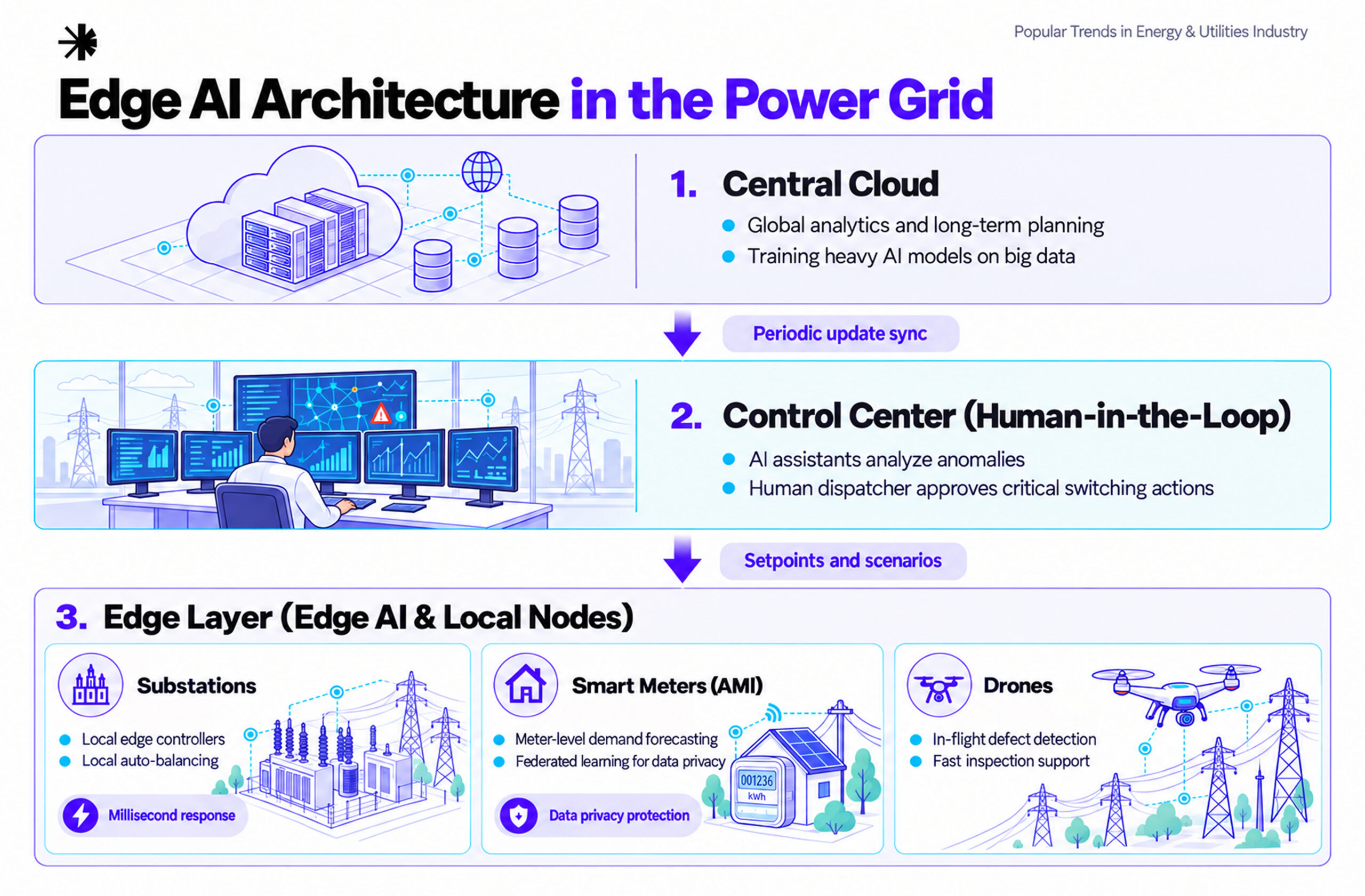
But even split-second Edge AI should not have the final say on large-scale switching. The third link in the chain is human operator control.
Trend 1.3. Human-in-the-Loop in Dispatch Control
Artificial intelligence is moving into grid operations fast. Gartner projects that operators powered by this technology will soon be deployed in 40% of utilities control rooms. At Rensai Labs, we always tell the companies we work with the same thing: use automation to narrow the decision, not make it.
These systems can scan thousands of signals, model scenarios, detect anomalies, and recommend the next move in seconds. For critical switching decisions, however, the final call should stay with the human operator.
The North American Electric Reliability Corporation (NERC) reinforces the need to design human-in-the-loop control deliberately, not add it as a checkbox.
AI can advise – your operator decides.
Trend 2: Grid Flexibility – Virtual Power Plants (VPP), BESS 2.0, and Long-Duration Storage
The energy sector is entering a new chapter. By 2027, the direction has become clear: utilities are moving toward a more flexible, software-driven grid. Across North America and Europe, the old model built around massive gigawatt-scale plants is giving way to one where AI, cloud platforms, and IoT manage flexibility dynamically. That shift sits at the core of energy and utilities industry digital transformation. To see the technologies behind it in more detail, explore renewable energy software.
Trend 2.1. Virtual Power Plants
A grid can’t efficiently manage thousands of batteries, EV chargers, and flexible loads as thousands of separate resources. VPP software makes that sprawl behave like a single dispatchable power plant. Among the major energy industry trends, VPPs are making the jump from a green niche to grid infrastructure.
Rensai Labs Insight
The grid does not always need another power plant. Sometimes it needs better energy software. The commercial “missing middle” (from office buildings and schools to shopping centers and logistics hubs) contains an enormous amount of flexible demand in the USA. Rensai Labs uses AI to sync HVAC and building storage, lowering the need for additional generation during high-load periods.
Trend 2.2. BESS 2.0: Smarter Battery Energy Storage Systems
These energy industry trends only work if your BESS can earn its keep and support the grid at the same time. That takes three digital tools:
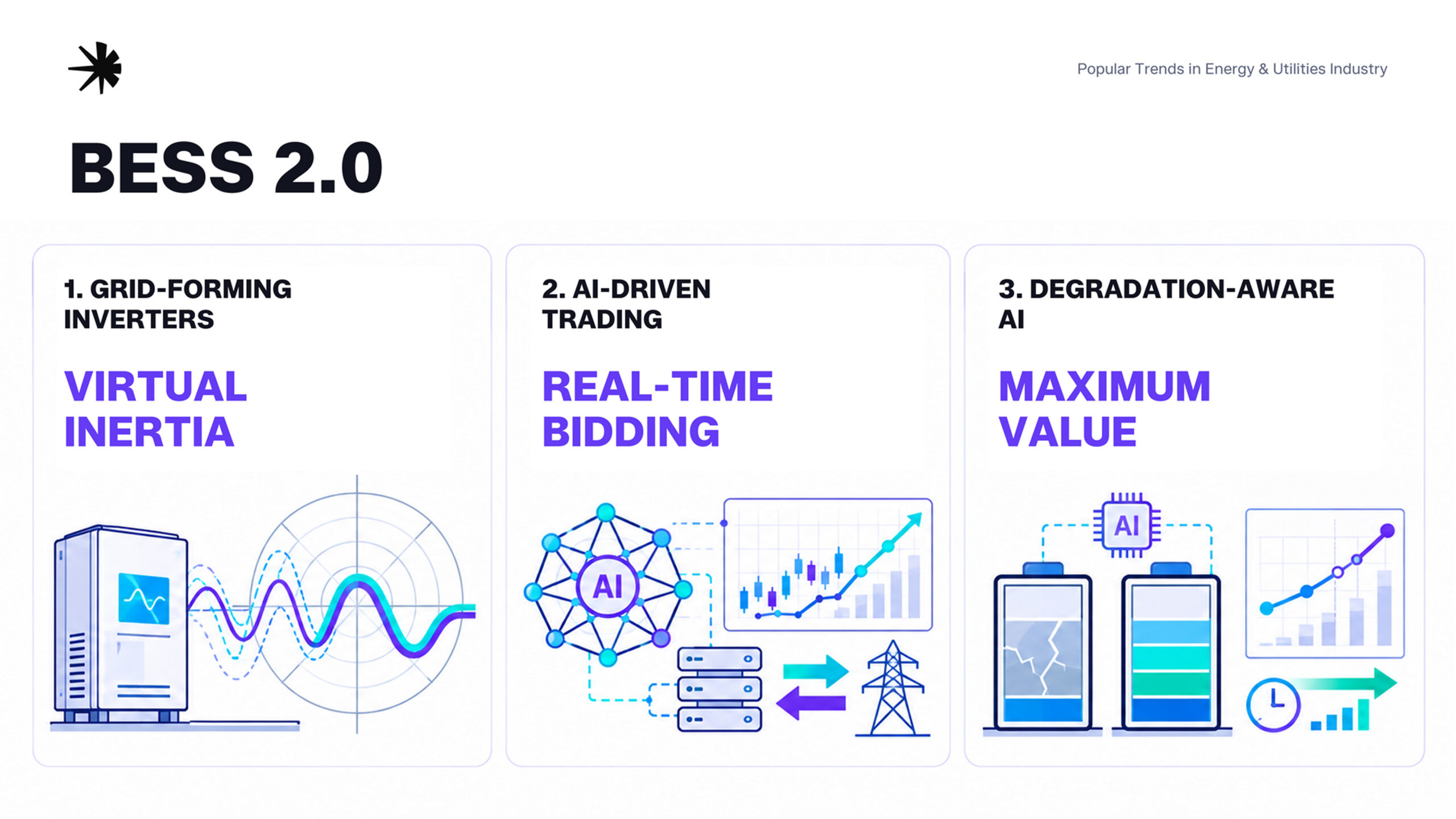
Grid-Forming Inverters
When large rotating turbines leave the system, the grid loses their natural inertia. Grid-forming inverter firmware recreates that effect digitally, generating virtual inertia and correcting frequency deviations within milliseconds.
AI-Driven Battery Trading
There is little reason for a modern battery to remain idle. With trading algorithms built into your energy management software, it can watch spot prices, optimize bids for grid services, and account for cell wear in the same decision loop. All in real time.
Degradation-Aware Artificial Intelligence
The system watches how your battery is aging, not just how much power it can deliver. By analyzing cell chemistry and physical condition, it helps you avoid many energy and utilities industry challenges and squeeze more value from every cycle. It can charge now, wait for a higher-priced peak, or protect the battery when another cycle is not worth the wear.
Trend 2.3. Digital Twins and Long-Duration Energy Storage
These technology trends in utilities industry grew out of a simple but brutal question: how do you keep the grid running when the sun stays away for weeks? The industry has a name for that problem: Dunkelflaute, a long winter lull with little wind and almost no solar generation. Lithium-ion batteries can bridge two to four hours. This problem can last for days or weeks.
Long-duration energy storage fills that gap. Hydrogen, gravity-based storage, and iron-air systems can hold energy far longer.
Yet without big data, operators cannot use that capacity intelligently.
Rensai Labs builds on these trends with a different class of mathematical planning. To make the software work harder for your business, we include predictive analytics and SCADA integration in our software development services for energy and utilities industry.
5-to-10 Day Predictive Analytics
When a prolonged wind and solar lull hits, operators may need to plan days ahead. That matters especially in wind-heavy markets like Texas, where shifts in weather can quickly change how much renewable power reaches the grid.
Predictive analytics gives your energy management software the foresight to handle that uncertainty. Here’s how it works: algorithms combine ensemble weather models with big data analytics to calculate the probability of extended generation shortfalls five to ten days ahead. They model both the risk and duration of the lull.
And predictive analytics is not limited to wind power. It can support planning and operations across the entire energy and utilities industry.
SCADA-Integrated Digital Twins
Your control room operator has more important things to do than study liquid-air thermodynamics or iron-air battery chemistry.
Energy management software takes that complexity off your hands. An LDES digital twin translates the system’s physical and chemical limits into familiar SCADA/EMS controls in real time:
– available power,
– setpoints,
– discharge schedules,
– response times.
Everything stays visible and easy to act on. For example, if storage conditions change, the twin can immediately recalculate the safe discharge rate.
Trend 3: Cybersecurity and Post-Quantum Protection in the Energy and Utilities Industry
Nearly all energy environment and utilities industry trends now intersect with cybersecurity. The logic is straightforward. Businesses have replaced isolated operational equipment with connected digital infrastructure, linking controllers to cloud services, IoT sensors, and enterprise ERP systems. That shift has blown the attack surface wide open. According to the World Economic Forum, 77% of utilities were hit last year by attacks tied to outdated software or unpatched legacy systems.
The moment your controllers start talking to the outside world, attackers get more ways in.
For Rensai Labs, staying ahead now comes down to three moves: a) adopt Zero Trust, b) counter AI-driven attacks with AI, and c) build for the post-quantum era. If your equipment has a 20- to 30-year lifespan, post-quantum protection cannot wait until these threats become real.
Trend 3.1. Zero Trust
Some energy and utilities industry challenges can end in costly failures that are far better prevented than cleaned up afterward. Zero Trust helps you stay ahead of those curveballs by continuously verifying every user, device, and command. That makes it a truly strong preventive defense for the energy and utilities industry.
|
Zero Trust Component |
How It Works |
What It Stops |
|
Software-Defined Microsegmentation |
Separates IT and operational technology environments → shuts down unused ports → blocks nonessential network services. |
A breach in the corporate network (for example, a phishing attack) cannot easily jump into OT and take control of a substation. |
|
Least Privilege Access |
Gets rid of permanent access and automatic trust. Controllers and gateways are opened only for a specific task and protected with multi-factor authentication. |
Cuts the risk of unauthorized access and account compromise – for employees and outside contractors alike. |
|
Automated Asset and Patch Management |
Keeps a live digital inventory of connected sensors, remote terminal units, and gateways while pushing firmware updates when needed. |
Spots rogue or unregistered connections fast and closes critical security gaps in legacy equipment. |
Last year’s cyberattacks in Poland demonstrated how fast threats cascade across unsegmented networks: attackers compromised 30+ wind and solar farms alongside a CHP plant heating nearly 500,000 people. Without Zero Trust, a single breach can rapidly escalate into a grid-wide crisis.

Trend 3.2. AI-Ready SecOps
Cyberattacks are starting to move at machine speed. That is changing both energy industry trends and the way companies approach software development services for energy and utilities industry. Today, attackers use artificial intelligence to sweep your operational networks for weak points, reverse-engineer firmware, and rapidly identify zero-day flaws in operational software. Yes, this is a different kind of threat.
Rensai Labs’ Golden Rule about Cybersecurity
When cyberattacks move at machine speed, human response is already too late. Rensai Labs’ golden rule: fight automation with automation. AI-driven SecOps must analyze industrial protocol flows in real time and learn baseline SCADA behavior. It should catch subtle anomalies early and isolate compromised segments before the problem moves from the screen to the substation.
Trend 3.3. Post-Quantum Cryptography Migration and Crypto-Agility
Your substations, protective relays, and controllers may stay online for 20 to 30 years. That means hardware installed today could still be operating in the 2030s and 2040s, when quantum computers may be capable of breaking conventional encryption. The real challenge is how long that equipment has to remain secure. Technology trends in utilities industry already show that companies across the sector are taking that timeline seriously.
We recommend building crypto-agility into your systems now. It gives you the architectural flexibility to update encryption algorithms at the microcode level without replacing expensive hardware. For the energy and utilities industry digital transformation, this is becoming a near-term priority, not a future upgrade.
The shift is now national. A June 2026 White House order requires federal agencies to accelerate migration to NIST-approved post-quantum cryptography, while critical infrastructure operators develop migration plans. NIST says its first post-quantum standards are ready to deploy.
Trend 4: Transformation in Supply Chains
According to Deloitte’s 2026 Outlook, the U.S. electric power sector needs more than $1.4 trillion through 2030, yet some of the equipment companies need can take years to secure. That’s the real problem. You cannot solve today’s utilities industry challenges with hardware alone. The sector is adding three digital engines to the mix: IT platforms, B2B marketplaces, and smart energy management software. We see this impact directly in our work at Rensai Labs.
For example, a recent IoT weather station management system project used automated telemetry and proactive maintenance to reduce equipment downtime by 30-40% and cut manual data corrections by over 70%.
That’s the trend worth watching.
Technologies Powering Supply Chain Resilience in the Energy and Utilities Industry
Reshoring and booking production capacity years in advance are only part of the response. Energy companies are also using digital and regulatory tools to get around equipment bottlenecks:
- Supply chain management (SCM) systems
- Grid-enhancing technologies (GETs)
- Digital regulatory sandboxes
Here’s how each one works.
Supply Chain Management Systems
The energy and utilities industry is seeing a clear trend toward smarter procurement planning. Gas turbines can take up to seven years to arrive, and transformers can take several. For your project, early planning becomes a risk radar for the construction schedule.
SCM platforms give you one view of contractors, stock levels, and construction progress. Rensai Labs can turn that into a supply intelligence layer, where AI flags emerging shortages, forecasts delays, and tells you which components to secure now before they stop work on site.
Grid-Enhancing Technologies
Before you spend millions of dollars on new transmission, make the existing grid work harder. Utilities pair sensors with specialized software that tracks weather and conductor temperatures in real time. That data lets operators safely push more electricity through existing lines without waiting years for new infrastructure.
Digital Regulatory Sandboxes
About a dozen U.S. states are moving grid approvals into regulatory sandboxes, where utilities can test modular substations and mobile transformers on digital twins first. That can cut years of review down to months. Connecticut caps the process at 18 months, forcing the timeline to move at project speed instead of bureaucratic speed.
Trend 5: Fintech Solutions and Service Models Driving Energy and Utilities Industry Digital Transformation
The energy and utilities industry is moving away from a capital-heavy model. Sustainable businesses are turning to IT subscriptions and fintech tools.
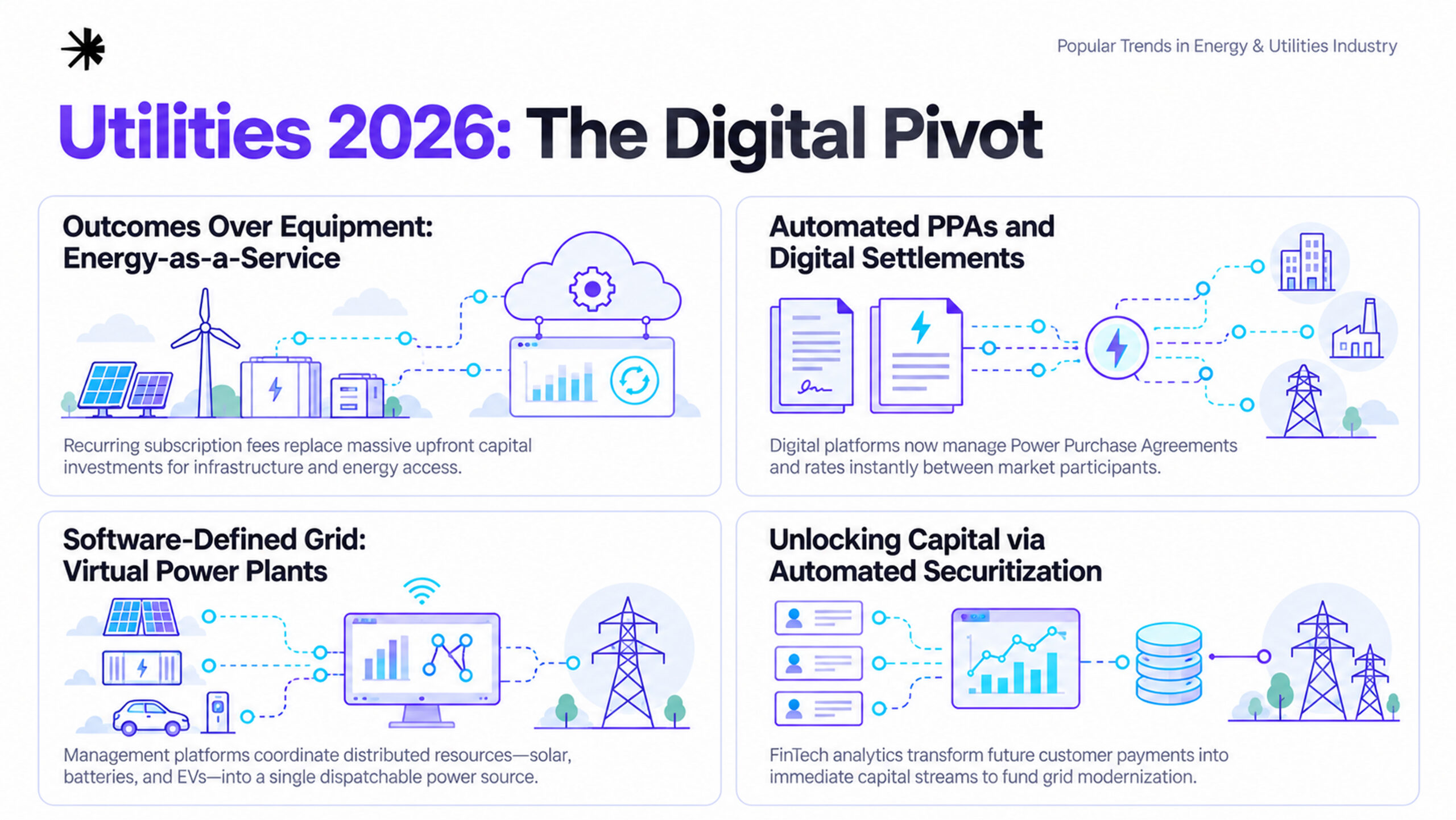
Service Models: Energy-as-a-Service and VPPs
Energy companies increasingly sell outcomes instead of equipment. Customers pay for access to energy, infrastructure, or a defined result:
- Energy-as-a-Service. A recurring fee replaces a large upfront capital investment.
- Virtual Power Plants. Energy management software coordinates solar panels, batteries, and other distributed energy resources – operators can dispatch them together.
- Automated PPAs. The digital platform manages power purchase agreements, rates, and settlements between energy-market participants.
Automated Securitization
Infrastructure financing is becoming another part of the energy sector being transformed by automation. Fintech analytics and ERP systems turn your future payments into a financial stream you can actively manage. They forecast revenue, model cash flow, and, most importantly, support securitization.
What does that look like in practice?
You no longer have to wait years to fund modernization. Companies can issue bonds backed by future customer payments and access capital sooner. Energy utility software monitors payments and helps you distribute costs over time so customers do not get hit with sudden rate increases.
Conclusion: Energy Is Becoming Software-Defined
The next phase of energy will be defined by energy management software taking control of more decisions that used to belong to hardware, operators, or fixed schedules.
- Artificial Intelligence is moving into substations.
- Batteries can decide when to trade, when to discharge, and when another cycle costs more than it earns.
- Digital twins can model the next few days before operators commit physical assets.
- Zero Trust is reaching deeper into operational systems.
- Supply chain platforms can expose shortages before construction crews feel them.
- Fintech tools are changing how companies fund the infrastructure in the first place.
These shifts point in the same direction. The grid is becoming more programmable.
That changes the equation for energy companies. Know where software can make the assets you already own more productive, flexible, resilient, and easier to manage, and a skilled IT team can turn virtually any energy and utilities industry trend to your advantage. Add the right time-to-market model, like the one we use with our clients, and new technology can be deployed at a reasonable cost, too.
Five years to build a substation. Five weeks to deploy an Edge AI controller or VPP platform. That difference captures where the energy industry is heading: the next generation of grid problems won’t be solved with concrete and tons of copper alone. Over the next decade, the highest ROI will come from software that makes existing capacity work twice as efficiently.