How Custom Software Transforms Construction and Energy Infrastructure
The United States saw virtually flat electricity demand for nearly 15 years, with annual growth below 1%. Now the curve is climbing again: McKinsey analysis projects growth of more than 3% a year.
This energy rally has two sponsors:
- Reshoring: Production is moving back to the United States, while the technology supply chains behind it are becoming more complex.
- AI boom: By 2030, data-center electricity demand could reach around 945 TWh – slightly more than Japan consumes today.
Against this backdrop, decarbonization becomes a harder challenge. The energy transition is moving at half the required pace for Paris-aligned 2050 targets. Meanwhile, the world will need roughly $106 trillion in infrastructure investment by 2040.
The U.S. Department of Energy puts buildings at 40% of national energy use. That makes construction part of the grid problem – and part of the solution. The two sectors now have to synchronize how they plan, build, and operate.
So where does custom software for construction fit into this?
Together, these pressures put capital productivity at the center of the U.S. power challenge. Custom software and predictive analytics can make that possible at scale, helping operators get more from the assets they already have. Buildings then become active, flexible parts of the power grid. Better still, engineering software solutions can be deployed early in the design process and used directly on the construction site.
In this article, Rensai Labs will break down the key integration pitfalls using a simple framework: problem → IT solution.
Why Custom Software for Construction Fits Complex Projects Better
Ready-made software (SaaS and COTS) can handle smaller, simpler projects in almost any industry, and we see that with clients all the time. The problem starts at the seams between industries. That is where processes become unusually complex and genuinely one of a kind.
Off-the-shelf software will happily promise “construction data analytics”, “real-time data integration” and “predictive maintenance.” Then your engineers walk into an actual substation or boiler room, and reality looks different: BACnet and Modbus conflicts, noisy IoT data, and systems that refuse to behave like the demo.
Vanilla COTS and SaaS platforms were built for standard conditions. Complex construction-energy systems are anything but standard. At this boundary, custom IT platforms can be the best software for managing energy infrastructure projects because the architecture matches reality on the ground.
Here are three arguments why:
Argument #1. Integrating BIM and IoT in Energy Construction
Most likely, you have already invested in, or are considering, millimeter-accurate laser scanning and a high-detail LOD 400 3D model with complete MEP specifications. But standard software will not unlock the full value of that investment.
How We Solve It
Building information modeling (BIM) captures how the asset was designed. Rensai Labs adds the layer that shows what it is doing now. Our middleware translates the model into open gbXML or IFC structures and overlays live IoT telemetry onto the same spatial framework.
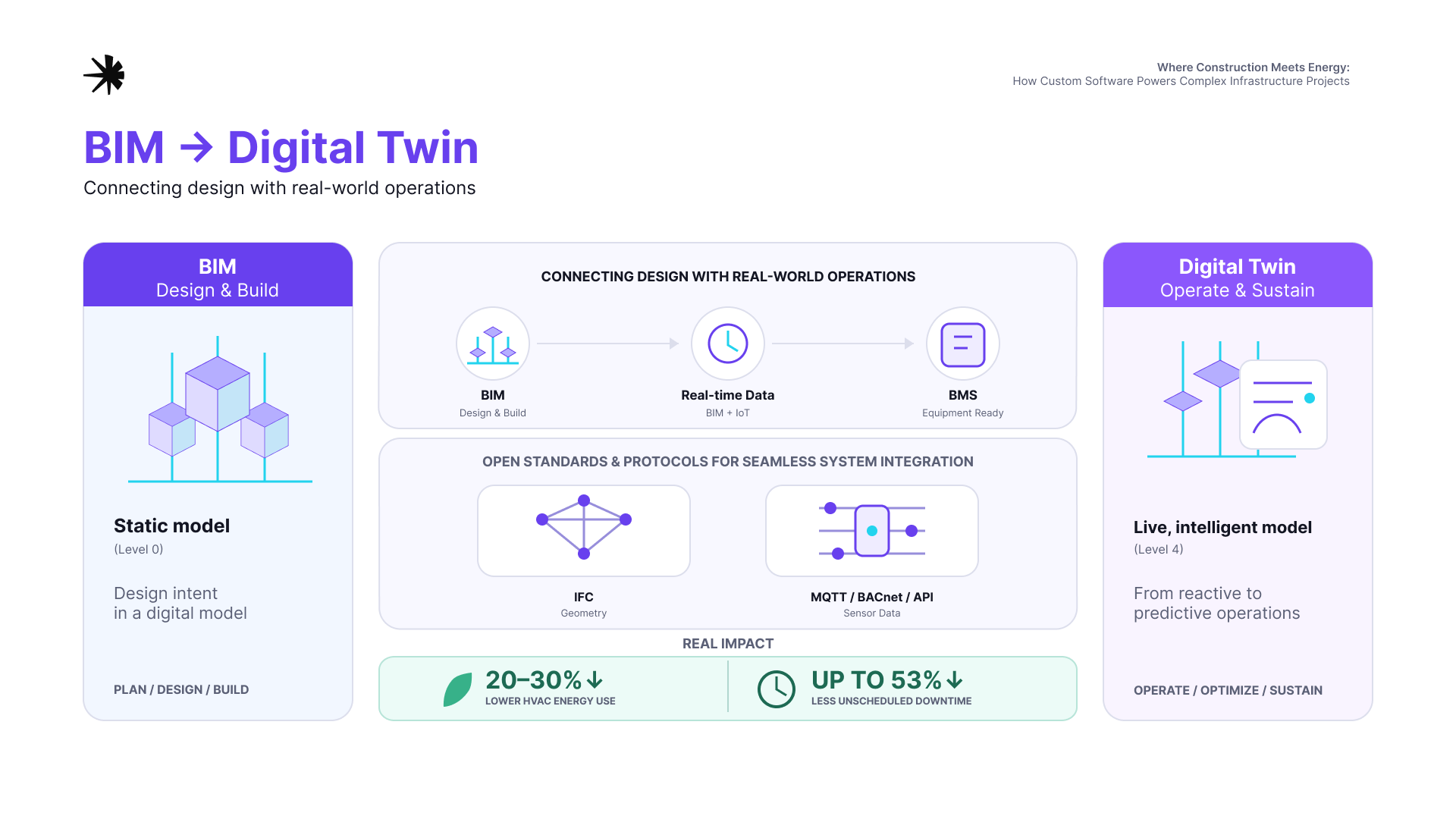
The static 3D model becomes a digital twin with a live thermal map. Truly live. The operator no longer sees a vague “HVAC failure” message. They can see exactly where the issue is developing, down to a specific zone on the fifth floor, for example, where air has entered the heating circuit.
Argument #2. Project Data Integration for Systems That Were Never Built to Work Together
Step into the basement of a modern commercial building or factory, and you will find a mix of systems that were never designed to speak the same language. The job is to connect them:
- A York chiller on BACnet/IP
- An industrial electricity meter on Modbus RTU
- A rooftop solar inverter and BESS
- Plus emissions and compliance data that may need to be submitted electronically to the EPA through systems such as e-GGRT or CEDRI
No COTS platform can pull all of this together on its own. Instead, it will politely send you back to “manual Excel imports” – a workaround that remains surprisingly common: 52% still use spreadsheets for field assets.
How We Solve It
Rensai Labs builds digital tools for sustainable construction that act as a universal gateway between field equipment, analytics, and ESG reporting. The system converts industrial Modbus data into InfluxDB analytics on the fly and automatically tags ESG metrics for CSRD reporting. You eliminate routine overhead and get a fully transparent digital trail for every kilowatt.
Argument #3. Using Infrastructure Modernization to Close the Energy Performance Gap
Design engineers love building green solutions into a project. Then operations begin, and the energy performance gap shows up: the real building can consume up to twice the energy projected on paper. Why? Off-the-shelf asset management systems often lack the equipment-level context needed to explain why actual energy performance drifts from the design model.
A real building is a live thermodynamic system. The sun disappears behind a cloud, or 20 people enter a conference room, and the thermal balance shifts in seconds.
How We Solve It
We train surrogate neural networks, including LSTMs, on computationally heavy physics simulations. Once trained, the AI can reproduce the thermodynamic behavior in milliseconds rather than waiting hours for a full simulation.
The software predicts what comes next and:
- Dims lighting before demand spikes
- Resets ERV/HRV ventilation setpoints
- Switches the building to local BESS power
It moves before sensors flag peak tariffs or uncomfortable indoor conditions. That is how a passive concrete box becomes an active prosumer, cutting OpEx by as much as 30%, according to Siemens Smart Infrastructure.
Key Use Cases: Energy Infrastructure Software in Action
Renewable Energy Projects
Does your company build utility-scale solar, wind farms, or hydropower facilities? Then you are dealing with a mix of logistical and physical challenges.
Nowhere is that scale more visible than in wind farm construction.
“Wind energy projects start with ultra-strong foundations engineered for enormous loads. Then come the logistics and the lifting: oversized blades, ultra-heavy equipment, and high-capacity cranes assembling structures that rise nearly 200 meters, or about 650 feet, into the sky. Every step requires precise coordination,” notes Vitaliy Sergey, an industry expert at Rensai Labs.
In this kind of environment, one delayed blade delivery, one idle crane, or one installation error at height can quickly translate into lost margin for the general contractor.
We build systems to coordinate complex renewable energy projects: they optimize component deliveries, schedule heavy-crane operations, and automate construction cost estimates.
But construction technology has a role long after project delivery. Once solar and wind assets go live, the problem shifts from moving equipment and coordinating crews to balancing generation with grid demand.
Unlike traditional generation, solar and wind power are stochastic by nature: their output depends on weather and often falls out of sync with daily peak demand in the U.S. We tackle that mismatch with predictive software that improves operational efficiency by helping operators forecast grid conditions, reduce ISO/RTO penalties, and minimize the risk of forced curtailment.
- AI-Based Forecasting: Algorithms correlate weather forecasts with expected demand across the power grid.
- Battery Energy Storage Management: Our software controls BESS charging when generation is abundant, then dispatches stored energy back to the grid when prices peak.
- Hybrid Dispatch: The system coordinates solar and wind with fast-ramping assets like gas peakers and CHP plants, closing supply gaps the moment they emerge.
Asset Lifecycle Management for Smart Grids and Utilities
For U.S. developers, one of the biggest benefits of custom software for construction companies is making compliance with applicable energy codes, ASHRAE standards, and LEED requirements easier to manage.
How do you prove that a building is actually as green in operation as it is on paper? Generic software usually stops at top-line consumption figures. Compliance needs more. Custom systems collect data directly from electricity, heat, water, and gas meters and turn that information into a full submetering framework.
“Digital transformation in construction takes energy monitoring beyond manual checks and into a live operating system. It tracks electricity and heat consumption, gives teams a clear view of energy-use patterns, and groups buildings by energy-efficiency class. More importantly, it continuously monitors every sensor on site, detecting anomalies and failures in real time. That means teams can direct maintenance resources to the right problem faster,” Vitaliy Sergey explains.
With Rensai Labs, you get a system that takes raw telemetry and makes it audit-ready for unit-level billing and verification against IPMVP and ASHRAE Guideline 14. The real advantage is early warning. By continuously tracking CV-RMSE and NMBE, the software checks whether the building is performing as designed and exposes deviations long before regulators show up at the door.
Modern custom software should put FDD (Fault Detection and Diagnostics) models to work. It is one of the most practical ways to apply AI – fewer technicians walking the site with paper checklists, less reactive maintenance after a failure, and more issues caught early.
Active Smart Grid Participation and BESS Management
Daily demand peaks are one of the biggest challenges for any power grid. Under time-of-use tariffs, electricity is often cheaper overnight, while morning and evening surges strain the system and make you pay a premium when demand is highest.
Building-to-Grid (B2G) flips the model. The building stops acting like a passive load and starts behaving like an active prosumer.
The control layer has two key parts:
- Grid Connectivity: OpenADR and IEEE 2030.5 give the building a live connection to the utility’s DERMS, allowing both sides to exchange data in real time.
- Smart Energy Dispatch: The software knows when grid power is about to get expensive. It charges local BESS overnight or from on-site renewables, then uses that stored energy during evening peaks. The result: less pressure on the grid and a lower energy bill.
Urban Infrastructure
Whole-Building LCA
Specialized software lets developers see the full picture before a building is built: its total carbon footprint and its economics across the entire lifecycle, from cradle to grave.
- Carbon Balance: The software accounts for the embodied carbon locked into construction materials, then forecasts the emissions the building will produce once it is in operation.
- CAPEX vs. OPEX: Yes, modern green materials can push CAPEX higher. But the upfront premium is only part of the story. The system models how lower operating costs reduce OPEX and when the investment pays back over the building lifecycle.
Municipal Dimming and Adaptive Lighting Control
What if you scale the same control logic across an entire smart city? Custom software can make outdoor lighting networks responsive to what is actually happening around them.
Imagine combining infrastructure data with live signals from traffic and pedestrian sensors:
- During the day and early evening, the system keeps lighting at the required level.
- Overnight, when traffic drops to very low levels, the algorithms gradually lower light output or selectively turn off lighting on unused road sections.
You stop burning electricity on empty asphalt. LEDs run cooler, energy use drops, and the municipality gets far more life out of the same equipment.
CEMS for Boiler Plants Rated 5 MW and Above
Once a utility or industrial facility reaches 5 MW (about 17 MMBtu/hr), U.S. environmental regulations require continuous automated emissions monitoring through CEMS. Custom software closes the gap between boiler instrumentation and regulatory databases, moving emissions data from the equipment to the systems regulators rely on.
- Real-Time Database and Telemetry Control: A custom middleware layer continuously ingests measurements from CEMS analyzers and other boiler instrumentation. Depending on the applicable rule, monitored parameters may include NOₓ, SO₂, CO, O₂, CO₂, and other emissions or process variables. The platform stores the telemetry in a time-series database such as InfluxDB and correlates emissions with the boiler unit’s operating maps at millisecond granularity.
- Electronic Compliance Reporting: The platform structures emissions and compliance data for the reporting format required by the applicable rule. For EPA-regulated stationary sources, this may include ERT or XML-based reports submitted through CDX/CEDRI.
- Predictive Penalty Prevention: Fault Detection and Diagnostics spots combustion anomalies before they escalate. As soon as emissions begin approaching regulatory limits, the software alerts the operator.
Vitaliy Sergey is more direct: “At 5 MW and above, there is no room for manual guesswork. Regulators want continuous, tamper-resistant CO₂ and NOₓ data, and operators need to know when combustion starts drifting before the limit is crossed. That is what custom software really buys you: a window to act. Correct the mix, change the boiler mode, fix the problem while it is still technical – before it becomes regulatory.”
Oil, Gas & Industrial Projects
Emergency repairs can cost three to five times more than planned maintenance, which makes reactive maintenance hard to justify in heavy industry. The good news is that software has opened a much wider set of options. With modern asset lifecycle management, operators can move from fixing failures to predicting, preventing, and planning around them.
Robotic Inspections (Edge AI)
Modern construction software development is moving beyond dashboards. We connect custom industrial platforms to autonomous drones and robots equipped with LiDAR and thermal imaging, sending machines into places where human inspection is slow, difficult, or expensive. Inside wind turbine blades, around hydrogen storage tanks, and across pipeline networks, they can flag structural defects up to an order of magnitude faster than human crews.
Predictive Maintenance Software
This is one example of how AI is changing construction project management: machine learning models read high-frequency streams of vibration, temperature, and pressure data straight from field sensors. They learn how components degrade and flag maintenance needs long before a failure takes equipment offline.
The Industrial Trilemma
In heavy industrial construction (oil and gas, petrochemicals, major plants), one old problem can create operational drag. That problem is the silo between operations, energy, and finance. Process engineers see what the equipment is doing. Energy teams see how much electricity, steam, and water it consumes. Finance sees the cost. But no one sees the full chain. So when resource use spikes, the company gets multiple explanations instead of one clear root cause.
The Unified Middleware
Project collaboration tools give every team the same operating picture. Our software builds the layer underneath it, pulling data from controllers and field instruments and connecting process conditions, energy use, and human activity in one continuous automated flow. Good software integration in infrastructure means those signals stop living in separate systems.
Digital Twin Technology
Earlier in this article, we explained how digital twins work. Now let’s look at how they are used in oil, gas, and industrial operations.
You do not test extreme operating scenarios in a working chemical plant, gas hub, or refinery. Real-world testing is too expensive and too dangerous. Rensai Labs builds a digital twin of the process instead, letting teams experiment in software before touching the real system.
As mentioned above, we start with building information modeling (BIM) to create a precise 3D representation of the facility, add mathematical models of its processes, and combine both into a digital twin. With industrial IoT in construction feeding the digital twin, engineers and operators can test scenarios they would never risk in the real plant.
Engineers can rehearse commissioning and simulate extreme or abnormal operating modes. The same environment lets them practice emergency containment without consuming real resources or putting people and costly assets in harm’s way.
The Business Impact: How Custom Software Improves Construction Project Efficiency and Sustainability

#1. Faster Project Delivery
Our infrastructure project management software gives teams tighter control over delivery timelines and minimizes the overhead of idle crews and equipment. Projects stay moving instead of paying for people and machinery to wait.
How We Do It
Infrastructure automation keeps the schedule live. The software continuously tracks:
- Critical paths to identify schedule risks early
- MEP specifications to keep work sequences aligned
- Logistics risks that could disrupt equipment and material deliveries
If a key delivery slips, the system recalculates hundreds of what-if scenarios in real time and adjusts the on-site work sequence.
#2. Lower Operational Costs
OpEx can drop by 15-30%, as we noted above. The savings come from getting the operating details right. Our developers apply eight years of energy-sector experience to every construction software build. Predictive MEP maintenance, HVAC calibration, and smarter space use become part of the core system logic. That is how sustainability in construction creates value long after handover.
How We Do It
The energy efficiency software continuously tracks:
- High-frequency submetering data to automate tenant billing and verify measured savings under IPMVP and ASHRAE Guideline 14
- HVAC telemetry with Fault Detection and Diagnostics to detect, diagnose, and classify mechanical issues with up to 92.6% accuracy
- Peak-demand data to coordinate local battery storage (BESS) and manage building-to-grid energy flows
- Local energy-sharing data to optimize peer-to-peer electricity trading across microgrids
When electricity prices spike during peak hours, the system automatically shifts the building load to on-site battery storage and adjusts temperature setpoints.
#3. Reduced Emissions
First, your construction project can cut its total carbon footprint by as much as 39%. The software layer matters here. Circular-economy planning tools track where materials come from, where they go, and what can stay in use during a retrofit. As energy sector digitalization reaches deeper into construction, that visibility helps keep reusable materials in circulation – and more waste out of the dumpster.
Second, smart infrastructure can lower both carbon emissions and HVAC costs. Our energy software development already targets this problem, cutting HVAC energy use by 13-19% without compromising indoor air quality.
Third, the control layer can scale decarbonization from a single building to whole neighborhoods and campuses.
#4. Improved Transparency and Stakeholder Trust
Construction site digitization gives companies a clear record of what actually happens on site. Every claim becomes easier to trace, verify, and defend, especially when greenwashing risk enters the picture.
How We Do It
Rensai Labs builds custom software for construction that integrates Scope 1, 2, and 3 emissions tracking directly into your operational workflow. The platform structures ESG metrics in compliance with GHG Protocol, TCFD, and California SB 253 standards. Every reported figure carries an immutable digital audit trail, allowing external verifiers to trace data in one click from physical site sensors directly to your annual disclosures.
Choosing the Right Software Partner
“Why pay a premium for specialized engineers when a generalist IT firm can ship the same code for less?” It is a question many U.S. developers and energy infrastructure operators still ask. The code may be cheaper – the education is not. If a generalist outsourcer has to learn the industry inside your facility, you are funding the lesson with time, rework, and risk. That hidden learning curve can quickly undermine cost control in construction.
| Comparison Point | Generalist IT Agency | Rensai Labs Engineering Approach |
|---|---|---|
| Industry Onboarding | 2-4 months of learning funded by the client. | 0 days. Engineers join the project with hands-on expertise in instrumentation, controls, and energy systems. |
| Protocol Stack | Standard web APIs; struggles with unfamiliar industrial protocols. | Industrial-native: BACnet, Modbus RTU/TCP, OpenADR, IEEE 2030.5, MQTT. |
| Architecture Limits | Monolithic or standard cloud architecture that can break under high-throughput telemetry. | Cloud-edge engineering built for high-frequency data and complex digital ecosystems in engineering, without major refactoring. |
| Compliance & Security | Standard SSL/TLS; potential risks during NIST and California SB 253 compliance reviews. | Enterprise governance: alignment with NIST 800-53, plus an immutable audit trail. |
| Code Rights | Dependence on proprietary libraries and vendor frameworks. | 100% IP transfer: full source code and architecture remain with the client. |
| Engagement Model | Long-term contract with upfront payment and no guaranteed outcome. | Risk-free PoC: a pilot running on live telemetry within 14-30 days, before committing the main project budget. |
If you are deciding how to choose software for complex infrastructure projects in the U.S., start with the team that will build it. We recommend putting every candidate through all six tests in the comparison table and making sure they can deliver on every one.
Future Outlook: The Rise of AI & Predictive Maintenance Software
“AI is the future of construction and energy,” Vitaliy Sergey argues. “The key takeaway for business leaders today is that AI is opening doors that were closed before. Until recently, sustainability and green initiatives often looked like a cost center with little financial upside. If meeting environmental standards and working toward UN Sustainable Development Goal 7 (Affordable and Clean Energy) used to hurt profitability, AI is changing that. Energy efficiency, once practical only for large corporations, is now within reach of mid-market companies and smaller businesses too.”
Rensai Labs clients use custom solutions and continue to see strong results across their construction and energy operations:
- Manage capacity: The software automatically decides which units to bring online and which to shut down or place on standby when demand drops.
- Optimize procurement and tariffs: The software adjusts purchasing, offers different tariffs to generators, and calculates compensation when shutdowns are required.
- Cut energy costs: The system manages each kilowatt-hour more efficiently, bringing down the cost per unit of energy.
If sustainability is on your agenda, Rensai Labs can build around that goal.