Renewable Energy Software: AI, Digital Twins, Cloud, and Green Engineering

Net-zero goals have moved far beyond romantic environmental ideas. Today, software developers face an engineering challenge at epic scale.
For decades, decarbonization was treated as the job of energy companies building solar farms and wind farms. But the economics have changed: according to the International Renewable Energy Agency, solar PV module prices have fallen by 90%+.
As hardware gets cheaper, the real bottleneck lies in control, integration, and, of course, software. That is where digital transformation in the energy sector now comes in.
Building gigawatts is the easy part. Making them work reliably inside a real power grid is much harder. By 2027, the main front of decarbonization will sit straight inside developers’ IDEs.
Software Risks in the U.S. Energy Market
For renewable energy software in the U.S., one of the biggest risks is data. During project design, critical information gets lost between incompatible CAD and GIS systems. Once the asset goes live, cloud platforms struggle to pull data from industrial control systems and protocols, making cloud sustainability metrics less reliable.
In major U.S. power markets like CAISO in California and ERCOT in Texas, this data gap costs money. Wholesale prices change every five minutes, and excess solar and wind power can push them below zero. If the energy software is too slow or cannot connect SCADA to the cloud, the system can sell power at a loss, discharge BESS at the wrong time, or face curtailment.
For development teams, that creates one major integration problem. But there is another issue hiding inside the software itself: its energy footprint.
- Integration chaos: High-volume telemetry, specialized energy protocols, and strict cybersecurity requirements all have to work together.
- The carbon footprint of code: U.S. data centers are scaling fast, while IT infrastructure consumes around 1.3% to 3% of global electricity.
“Clients often ask us what software can do for renewable energy, and those conversations have naturally turned into a long list of things companies across the sector need to know. That is why Rensai Labs launched a dedicated series on the software behind sustainability in the energy industry. We now look at how software itself can support decarbonization. Especially now, as McKinsey estimates that system optimization could cut global CO₂ emissions by 5% by 2030.”
– Irina Chirikova, Head of Marketing at Rensai Labs
The Hidden Software Behind Green Energy
First, modern green IT infrastructure for energy firms gives turbines, power grids, and solar plants a digital autopilot that monitors and controls operations around the clock. That includes:
- Energy management systems (EMS/DERMS)
- IoT for energy platforms
- Predictive maintenance systems
Here is what the best green software for energy companies looks like in the real world. Imagine a wind farm with hundreds of turbines. Every turbine constantly produces gigabytes of data, from gearbox bearing vibration and oil temperature to yaw angles and wake behavior. Embedded IoT sensors stream that telemetry to cloud-based predictive maintenance algorithms.
Built-in AI can spot hidden bearing wear or blade misalignment 60-90 days before failure becomes critical. That window matters: you can order parts, schedule maintenance for a low-wind day, cut downtime by up to 35%, and reduce maintenance costs by 25%.
At grid scale, DERMS platforms and virtual power plants (VPPs) pull thousands of rooftop solar systems, industrial batteries (BESS), and EV chargers into one controllable power pool, then respond to grid signals almost instantly.
But how sustainable is the software powering this green technology?
What Is Green Software Engineering
According to the International Energy Agency (IEA), data centers accounted for around 1.5% of global electricity consumption in 2024, and that share could nearly double by 2030. Cooling alone can account for more than 30% of a less-efficient data center’s electricity use. That is why Green Software Engineering is gaining ground across the industry: developers design code for greater energy efficiency and a lower carbon footprint throughout the entire software lifecycle.
At Rensai Labs, Green Software Engineering means cutting waste at the code level. We do it in three ways:
- Replace compute-heavy algorithms with linear alternatives.
- Strip out unnecessary network traffic and compress telemetry from billions of smart meters, so energy data analytics uses fewer resources.
- Track the carbon footprint of every release using standards like Software Carbon Intensity, and build carbon accounting into the development process.
Legacy Code and Sustainable Infrastructure
Retire legacy systems. If you have not done it yet, it should have been priority No. 1 yesterday. When operators try to run the energy transition on outdated IT stacks, patchwork automation, and Excel spreadsheets, they lose the very benefits modernization is supposed to deliver – speed, margin, and control.
Legacy architectures create direct financial and energy losses for several reasons. Beyond the OT/IT gap, poor integration with modern smart grid technology, losses in volatile U.S. markets, and reactive maintenance instead of predictive maintenance, the important problems are:
- Hybrid systems working out of sync – Without one system coordinating solar, wind, and batteries, each asset responds to grid commands on its own. A battery may start charging when it should be sending power back to the grid. That mismatch can cost operators 8%-15% of potential revenue and hurt renewable grid optimization.
- Point-solution chaos – As you keep adding specialized tools to a climate tech stack, you create Spaghetti Architecture, and the system starts fighting itself. Licensing and integration costs rise, while performance and system resilience drop.
Why Energy Companies Must Rethink Their Digital Infrastructure
Renewables scale fast – IT debt scales faster. Add thousands of inverters, expand generation, or deploy BESS across the network, and sooner or later the infrastructure hits a point where yesterday’s architecture can no longer carry tomorrow’s load. That is where renewable energy digital transformation strategies stop being optional.
Rensai Labs recommends that energy companies revisit four key areas as they adopt emerging clean tech solutions:
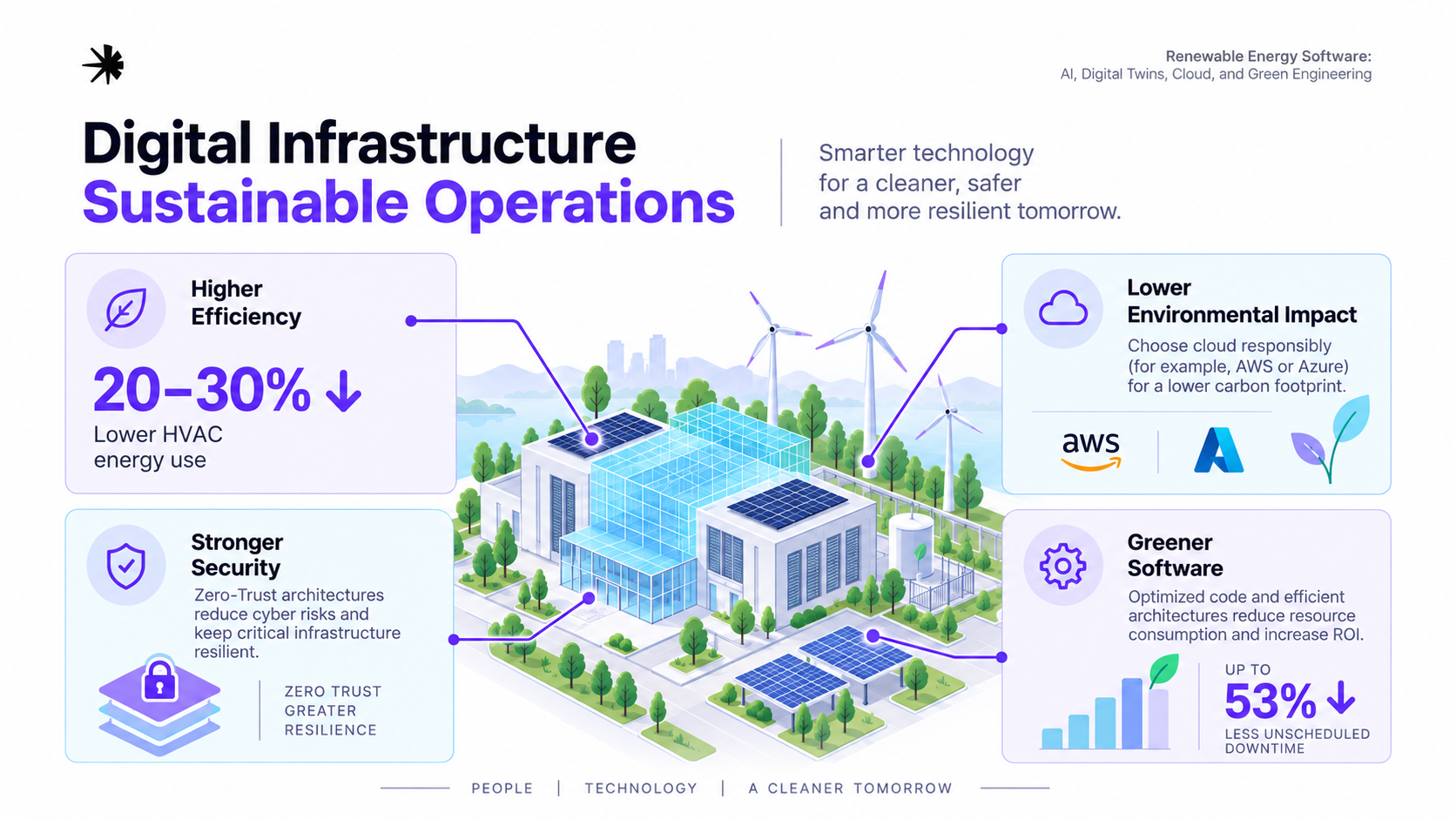
- Cybersecurity & compliance → More data, more risk.
- Software efficiency → Better sustainability metrics.
- Cloud choice → AWS vs. Azure carbon-neutral performance.
- Cost-benefit → Greener systems, leaner operations.
Cybersecurity & Compliance: The $1M-a-Day Regulatory Reality
So, here are the two main regulatory challenges every asset owner in the U.S. needs to be ready for:
Challenge 1. NERC Category 2 Tightens the Rules
NERC lowered the mandatory registration threshold from 75 MVA to 20 MVA for facilities connected at 60 kV or above.
The most important part: the new rules include no grandfather clause – existing facilities do not get a pass. More than 1,000 operating solar and battery sites across the U.S. must quickly add round-the-clock telemetry and full remote dispatch capability. Fail to comply, and fines can reach $1 million a day.
Challenge 2. Hard OT/IT Separation and New Security Standards
NERC CIP-003-9 tightens security around vendor remote access. NERC MOD-026-2 pushes operators to prove voltage-control models with real field EMT tests, not just factory paperwork.
Strategic Cloud Choice: AWS vs. Azure vs. Google Cloud
Once SCADA telemetry, VPP orchestration, and predictive analytics move off-prem, your cloud choice starts shaping your Scope 3 footprint. That is why low-carbon cloud computing for energy companies has become part of the architecture itself. AWS, Azure, and Google Cloud each bring a different carbon play:
Google Cloud Platform
GCP leads industry efforts in round-the-clock clean energy, anchored by Google’s official target to operate on 100% Carbon-Free Energy by 2030. Its Demand Shaping tools can automatically shift heavy batch workloads, such as retraining ML models for wind forecasting, to the hours and regions where wind and solar make up more of the regional electricity mix. Combined with Google Cloud Carbon Footprint, that gives companies better visibility into workload emissions and a stronger foundation for building sustainable digital systems.
Microsoft Azure
Azure makes emissions reporting easier to defend. Its Emissions Impact Dashboard tracks the footprint of your cloud infrastructure and gives investors and regulators the numbers behind your sustainability reporting.
Amazon Web Services (AWS)
AWS pushes green innovation down to the chip level with its custom ARM-based Graviton3 and Graviton4 processors. They deliver up to 60% better energy efficiency per compute operation than traditional x86-based architectures.
Believing Google or AWS will fix the problem for you? It’s a dangerous illusion. Servers do not care what they execute. Bad code will still burn through kilowatt-hours, even inside the greenest data center. At Rensai Labs, workloads follow the cleanest, cheapest power.
Our Carbon-Aware architecture tracks grid emissions across global data centers in real time and automatically moves compute to locations where surplus clean energy brings prices down. At that point, IT infrastructure stops being a silent source of emissions and becomes a flexible autopilot for sustainability. And, to the CFO’s pleasant surprise, it also cuts cloud bills significantly.
How to Build (or Buy) Software That’s Truly Green
Where should energy leaders start? With digital twins and predictive AI. Major U.S. players like NextEra Energy, Duke Energy, and Southern Company are already putting these technologies to work.
The next question when building (or buying) software that’s truly green? What AI can actually deliver for your business, not just what it promises on paper.
Here’s how software supports renewable energy: Rensai Labs combines ML models, satellite cloud-cover imagery, weather radar data, and physics models for individual generators. Software built this way cuts forecasting errors even in challenging weather conditions.
Digital Twins
In the context of digital sustainability strategy, this technology lets you monitor how solar farms, wind turbines, and BESS should perform versus how they actually perform.
The platform compares real equipment data with ideal physics-based models, 24/7:
- Inverters and BESS – Software solutions for sustainable power management detect early cell degradation and instantly flag overheating and voltage anomalies before protective systems trip.
- Solar arrays –Clean tech solutions automatically detect soiling and precisely locate faulty string inverters and trackers.
When built using sustainable software development practices, digital twins can also help reduce waste in energy operations. But what does that mean for mid-sized energy companies, especially in the U.S.? This is where the economics get interesting – you gain full visibility into asset health without constantly sending crews into the field. In Rensai Labs’ energy projects, this approach has cut clients’ routine inspection costs significantly.
Green Technology Buying Checklist: Five Questions to Ask Your IT Partner
If you’re buying an off-the-shelf platform or hiring a technology partner instead of building system from scratch, use these five questions to evaluate your options and identify trusted green software vendors:
Question 1. Do you calculate Software Carbon Intensity (SCI)?
If a vendor claims to be green but cannot tell you how much CO₂ its software emits per 1,000 API requests or transactions, that’s greenwashing, not data-backed sustainability.
Question 2. How does your system handle telemetry at scale?
We recommend asking whether your IT partner follows industry best practices by using purpose-built time-series databases like TimescaleDB with downsampling. If not, you could end up paying to store gigabytes of raw data in inefficient databases.
Question 3. Does your architecture support open protocols and avoid vendor lock-in?
Does your software support IEEE 2030.5 and OpenADR 2.0/3.0, meet IEC 62443 security requirements, and let you connect inverters, BESS, and smart meters from different manufacturers without locking you into one vendor’s ecosystem? That’s essential for scaling renewable power generation.
Question 4. Is your sustainable energy platform modular or built on spaghetti architecture?
Stitching together dozens of disconnected point solutions puts extra strain on integration adapters, drives up licensing costs, and increases the server capacity you need.
Question 5. Does your energy software support Carbon-Aware computing and dynamic workload shifting?
The real test is whether the system can automatically shift background jobs to times when clean energy makes up the largest share of the grid, helping reduce their environmental impact.
Tax Incentives and Regulatory Tracking
Meeting 2030 sustainability goals means looking beyond cleaner technology. Renewable energy companies also need to navigate a maze of legal and regulatory requirements. Miss an ESG compliance requirement, and your business could face costly consequences. Overlook a tax incentive, and you’re leaving money on the table. The solution? Track it all through custom software.
Their checklist should cover:
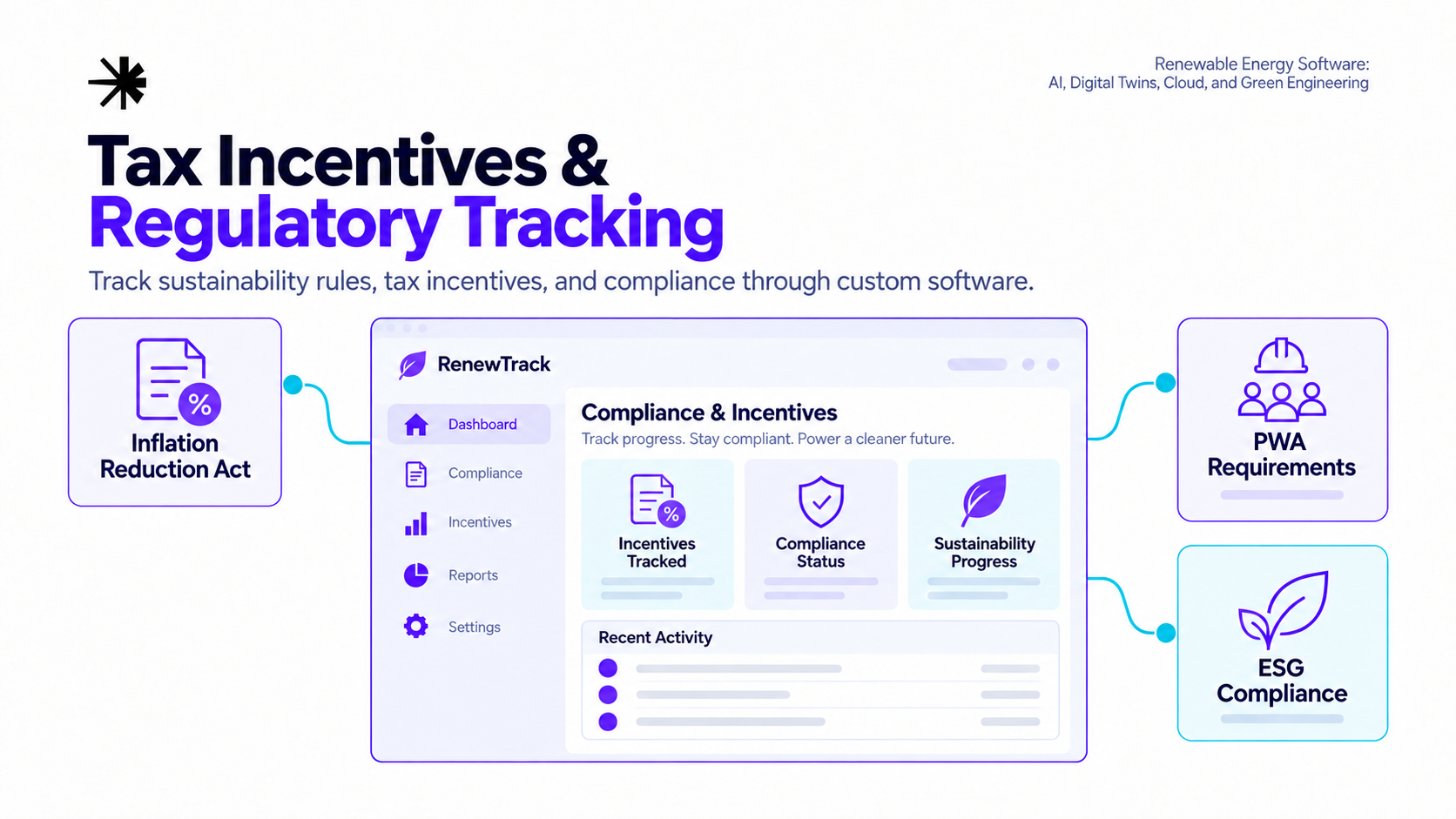
The Inflation Reduction Act
IRA’s wage and apprenticeship requirements. Then comes the paperwork. A subcontractor has left the site, and the payroll records are missing. Suddenly, millions in tax benefits hang on documents nobody can find.
Now add a ticking clock. Under the One Big Beautiful Bill Act, wind and solar projects starting construction after July 4, 2026, generally need to be running by December 31, 2027, to qualify for clean energy tax credits. For these projects, two major hurdles stand in the way. You need to prove compliance and get the project running on time.
Wages, apprenticeship hours, domestic content, project start dates – every detail needs a reliable digital trail.
“What does a fivefold payoff look like in real dollars? As the ITC rate climbs from 6% to 30%, a $200 million project could qualify for a $60 million tax credit instead of $12 million. In this example, the production tax credit also jumps from $0.005 to $0.025 per kWh.
The bonus doesn’t stop there. Meet U.S. domestic content requirements, and that 30% rate could climb to 40%.
Want to make sure you don’t lose out? Keep a close eye on contractor compliance. Pay workers the applicable prevailing wage rates published on SAM.gov and ensure qualified apprentices perform at least 15% of eligible project labor hours. And there’s one more rule. If a contractor has four or more people working on the project, at least one must be a qualified apprentice, as outlined in the IRS Prevailing Wage and Apprenticeship requirements.”
– Andrey Sushevich, Chief Software Architect at Rensai Labs
Prevailing Wage
As the green project owner, you’re ultimately responsible for PWA compliance – even when your subcontractors make the mistakes. The IRS could come knocking years after work on the site ends. By then, tracking down paper timesheets from crews that left the site long ago may be nearly impossible.
What could this cost you?
- Direct penalties: $5,000 per underpaid worker and $50 for each missing apprentice labor hour. Deliberately ignore the rules? Up to $10,000 per worker and $500 per hour.
- Worst-case scenario: Unresolved violations could cost you the 5× multiplier, cutting your tax credit from 30% to 6%.
* Before counting on the 5× credit, check your clean energy project’s eligibility, timeline, and supply chain against the latest IRS guidance.
ESG Value Matrix for Clean Software: Actionable Insights for CTOs
| Dimension | Key Methods | Business Impact |
|---|---|---|
| Environmental | • Measure Software Carbon Intensity. • Use carbon-aware computing to shift workloads to periods when cleaner electricity is available. • Downsample telemetry data in purpose-built time-series databases such as TimescaleDB. |
• Reduce unnecessary computing and data storage costs. • Lower the carbon footprint of software operations. • Make software-related emissions measurable and easier to manage. |
| Social | • Verify payroll and timesheet data. • Monitor apprenticeship requirements, including the 15% labor-hours threshold where applicable. • Use 3D/VR simulations. |
• Help eligible projects claim up to 30% in clean energy tax credits. • Improve safety for field engineers. |
| Governance | • Automate emissions reporting. • Apply OT/IT security controls informed by NERC CIP and IEC 62443. • Track compliance with domestic content requirements. |
• Reduce exposure to regulatory penalties and cybersecurity risks. • Improve audit readiness and reporting transparency. • Support eligibility assessments for applicable domestic content incentives. |
Conclusion: The Future of Energy Tech Is Where Data, Energy, and Sustainability Converge
- Hardware is becoming less of a differentiator. Solar panels and BESS cost less than ever. The money now depends on how accurately your algorithms trade in volatile electricity markets.
- Excel could cost you $48 million in tax credits. Leave a PWA timesheet error unresolved, and your IRA credit could drop from 30% to 6%. Software helps protect your investment when the IRS comes knocking.
- Protect battery life. Predictive AI and digital twins detect early signs of degradation, extending BESS lifespan and safeguarding renewable energy project ROI.
- Reduce the risk of NERC CIP fines. Automated telemetry monitoring helps secure OT systems and reduces exposure to fines exceeding $1 million per day.
- Green code cuts hosting costs by 3-5×. Carbon-aware computing and data downsampling slash IT expenses and shrink software’s own carbon footprint.
- Automated Domestic Content Tracking. Automatically calculate the share of U.S.-made components and qualify for a potential 10-percentage-point ITC bonus while keeping EPC contractors’ cost data confidential.
- 20-30% EBITDA upside. No new CAPEX, algorithmic optimization can boost margins at existing energy facilities without buying more equipment.
Here’s the paradox of today’s energy market: a company running 500 MW with predictive software can out-earn a giant operating 2 GW of solar panels practically blind. If your system fails to boost EBITDA or protect your physical assets, you risk paying a premium for greenwashing.
The takeaway? In today’s energy market, physical assets and digital intelligence increasingly work as one economic system.
FAQ
Can cloud algorithms read legacy SCADA metrics with zero write-back risk?
Yes. A segmented, one-way architecture can enable secure, read-only access to industrial data in four steps:
- Avoid direct controller access. Collect data from historians or OPC UA gateways configured for read-only access.
- Block reverse traffic. Use hardware data diodes to enforce one-way data transfer.
- Isolate analytics workloads. Process data in the cloud to minimize the load on local SCADA systems.
- Secure access points. Monitor and control network connections to support applicable NERC CIP and IEC 62443 requirements.
What data does predictive AI need to detect equipment failures before they happen?
Here’s how AI optimizes renewable energy production: to detect equipment faults as early as 60-90 days before failure, it needs data from multiple sources:
- Mechanical performance and vibration. Rotational speed (RPM), torque, and vibration and acoustic data from gearboxes and bearings.
- Electrical and chemical health. Voltage spikes, partial discharges, localized overheating, and dissolved gas analysis (DGA) of insulating oil.
- Weather context. AI uses weather radar data, solar irradiance, and wind speed to distinguish normal drops in power output from equipment wear.
- Digital asset records and logs. SCADA/PLC error codes, maintenance records, and LiDAR-based 3D models help climate tech systems compare real-time performance against a baseline.
How do digital twins differ from traditional monitoring and predictive maintenance systems?
What sets a digital twin apart is its two-way connection to a physical asset. The virtual model mirrors the asset in real time and continuously exchanges data with it.
Traditional monitoring shows what’s happening now. Predictive analytics studies historical trends to predict failures. A digital twin changes the equation – it recreates an entire green energy system, including its physical and spatial context. Companies can then experiment with what-if scenarios and run stress tests in a virtual environment, without touching the live system.
How can companies measure the carbon footprint of their software in practice?
To measure software’s true environmental footprint, start with Software Carbon Intensity per API call. Cloud providers give you a baseline for server emissions, while code profilers expose wasted CPU cycles buried in your business logic. Where’s the biggest payoff for decarbonization? Carbon-aware systems that dynamically shift background computing to the hours and regions where wind and solar farms generate the most surplus power.